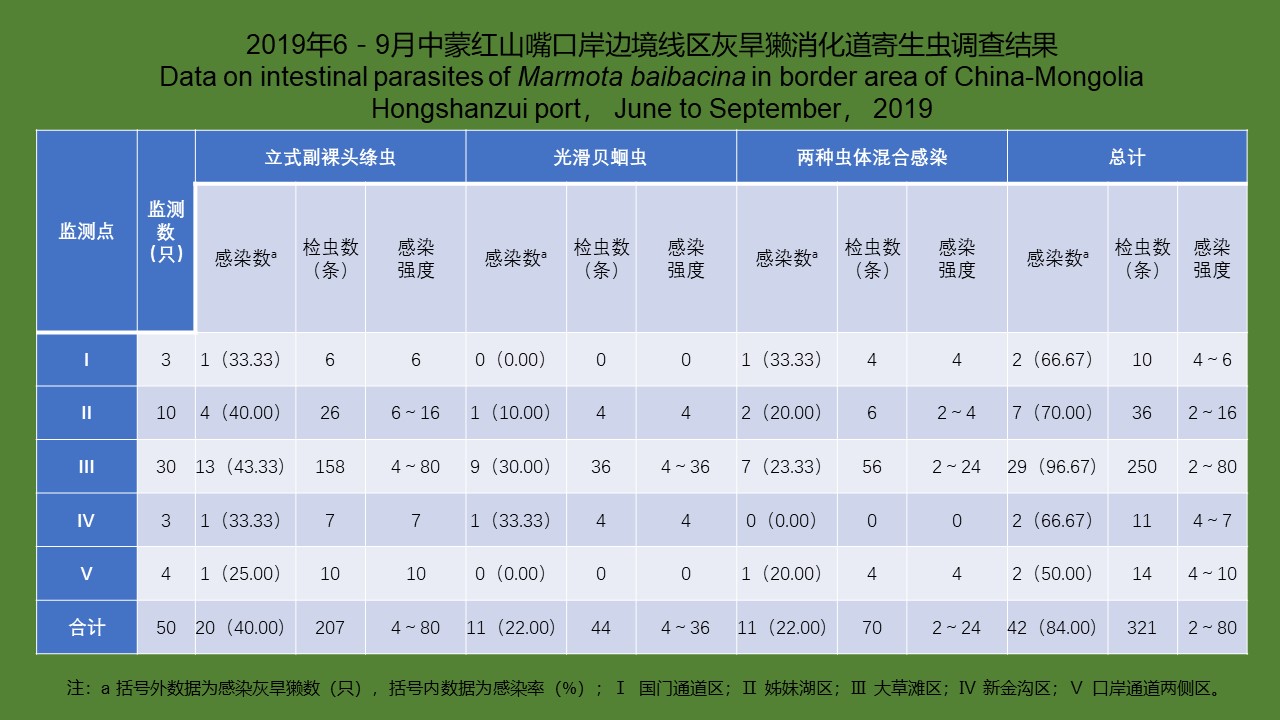
Objective To provide basic data for understanding and preventing the spread of zoonotic parasitic diseases caused by Marmota baibacina across the border between China and Mongolia. Methods In 2019, M. baibacina was captured by patrol and trapping in the border area of China-Mongolia Hongshanzui port, and investigated the distribution and epidemiological characteristics of intestinal parasites in M. baibacina. The species of the parasites was identified after hematoxylin staining, dehydration, xylene clearing, and paraffin embedding. Results Two species of parasites, Paranoplocephala ryjikovi and Baylisascaris laevis, were found in the intestine of 50 M. baibacina, with an overall infection rate of 84.00%. A total of 321 parasites were obtained, with infection intensities of 2-80. Excretion of tapeworm segments from the marmots was observed, and eggs were detected in feces. The infection was prevalent across the whole border area of Hongshanzui. Conclusion It is the first time to find P. ryjikovi and B. laevis in the intestine of M. baibacina in the border area of China-Mongolia Hongshanzui port, which provides a basis for preventing the international spread of zoonotic parasitic diseases across the China-Mongolia border area and promoting the healthy development of animal husbandry.
LIU Ge, ZHANG Hui, KAMAILE Ji-ge-er, BAI Cen, ZHANG Zhao-guan, MENG Yong-wen, JIA Li, WANG Dong-sheng, YIN Da, YIN Xiao-ping
. A preliminary study of intestinal parasites in Marmota baibacina in the Hongshanzui border area between China and Mongolia[J]. Chinese Journal of Vector Biology and Control, 2022
, 33(2)
: 301
-304
.
DOI: 10.11853/j.issn.1003.8280.2022.02.026
[1] 周旭东. 新疆荒漠鼠类体内寄生虫的调查与研究[D]. 乌鲁木齐:新疆大学, 2005. DOI:10.7666/d.Y758460. Zhou XD. Survey and research on endoparasite of vole in the desert of Xinjiang[D]. Urumqi:Xinjiang University, 2005. DOI:10.7666/d.Y758460.(in Chinese)
[2] 张静宵, 刘海青, 刘玉芳, 等. 野生白化喜马拉雅旱獭重要病原体检测与控制研究[J]. 中国病原生物学杂志, 2015, 10(8):704-708. DOI:10.13350/j.cjpb.150808. Zhang JX, Liu HQ, Liu YF, et al. A study of the major pathogens infecting albino Himalayan marmots and techniques to control those pathogens[J]. J Pathog Biol, 2015, 10(8):704-708. DOI:10.13350/j.cjpb.150808.(in Chinese)
[3] 卢俊杰, 殷宏. 鼠、兔寄生线虫图谱[M]. 兰州:甘肃科学技术出版社, 2016:11-269. Lu JJ, Yin H. Atlas of parasitic nematodes in rats and rabbits[M]. Lanzhou:Gansu Science and Technology Press, 2016:11-269. (in Chinese)
[4] 席耐, 党新生. 旋尾目线虫一新种的描述(柔线科:柔线属)[J]. 中国兽医寄生虫病, 2002, 10(1):12-15. DOI:10.3969/j.issn.1674-6422.2002.01.004. Xi N, Dang XS. Habronema hejing:A new species nematode of spirurida (Habronematidae:Habronema)[J]. Chin J Vet Parasitol, 2002, 10(1):12-15. DOI:10.3969/j.issn.1674-6422. 2002.01.004.(in Chinese)
[5] 关家震, 林宇光. 川西北高原裸头科绦虫调查及双宫带属一新种记述[J]. 动物学研究, 1991, 12(2):147-154. Guan JZ, Lin YG. Investigation of anoplocephalid cestodes in northwest plataeu of Sichuan, with discription of Diuterinotaenia daofuensis[J]:Zool Res, 1991, 12(2):147-154. (in Chinese)
[6] 林宇光, 关家震, 王芃芃, 等. 立氏副裸头绦虫的生活史研究[J]. 动物学报, 1982, 28(3):262-270. Lin YG, Guan JZ, Wang PP, et al. Studies on the developmental cycle of Paranoplocephala ryjikovi Spassky, 1950 in the intermediate host[J]. Acta Zool Sin, 1982, 28(3):262-270. (in Chinese)
[7] 林宇光, 关家震, 王芃芃, 等. 横转副裸头绦虫的发育史研究[J]. 动物学报, 1982, 28(4):368-376. Lin YG, Guan JZ, Wang PP, et al. On the developmental cycle of the marmot cestode, Paranoplocephala transversaria (Krabbe, 1879), in the intermediate host[J]. Acta Zool Sin, 1982, 28(4):368-376. (in Chinese)

