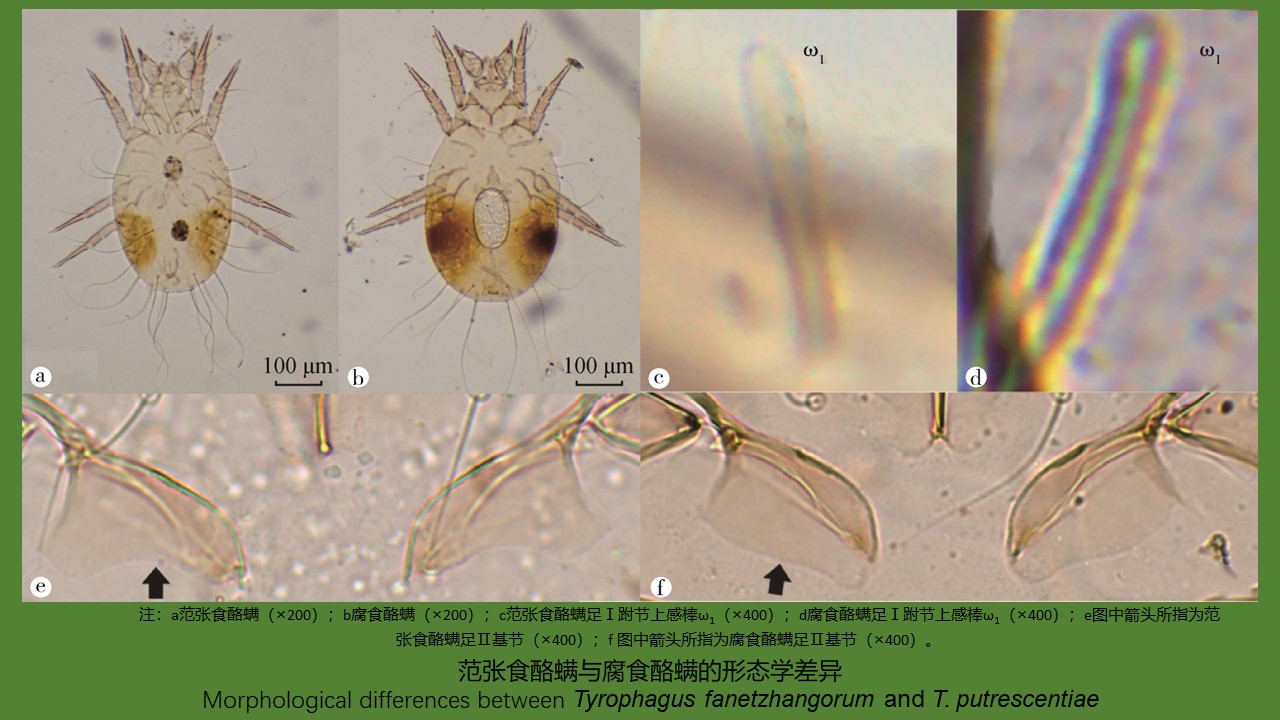
Objective To identify Tyrophagus fanetzhangorum and T. putrescentiae by morphological and molecular methods. Methods Samples were collected from houses and stored products, and individual mites were selected for pure culture. The cultured adult mites were used to prepare slide specimens for morphological identification based on the taxonomic keys of Astigmata. Subsequently, genomic DNA was extracted from individual mites for the PCR amplification, and sequencing of mitochondrial cytochrome c oxidase subunit Ⅰ gene (CO Ⅰ). The resulting sequences were subjected to homology search using BLAST in NCBI. The CO Ⅰ sequences of T. fanetzhangorum and T. putrescentiae were aligned using Clustal Ⅹ 1.83. Sequence analysis was performed using MEGA Ⅹ, and a phylogenetic tree was constructed using the maximum likelihood method. Results The posterior 1/3 of the coxal plate Ⅱ of T. fanetzhangorum was concave, the inferior margin was "S" shaped, and the distal 2/3 of solenidion ω1 on tarsus Ⅰ obviously widened. The coxal plate Ⅱ of T. putrescentiae was triangular, the inferior margin was straight or slightly concave, and the solenidion ω1 on tarsus Ⅰ widened at the distal 1/4. The CO Ⅰ gene sequences of the isolated T. fanetzhangorum and T. putrescentiae showed >99.00% similarity with the CO Ⅰ gene sequences of T. fanetzhangorum and T. putrescentiae in GenBank. The phylogenetic tree showed that T. fanetzhangorum and T. putrescentiae clustered into a branch with a bootstrap value of 100%. Conclusion Identification of T. fanetzhangorum and T. putrescentiae can be performed based on morphological characteristics or molecular analysis of the COⅠ gene. The combination of morphological and molecular identification can improve the accuracy of the identification of closely related mite species.
FAN Xiao-chen, LIU Lu-yao, FANG Yu, CHU Ling-miao, FENG Rui, LI Fei-yan, PAN Ruo-xi, WANG Shao-sheng, SUN En-tao
. Morphological and molecular biological identification of Tyrophagus fanetzhangorum and T. putrescentiae[J]. Chinese Journal of Vector Biology and Control, 2022
, 33(2)
: 277
-280
.
DOI: 10.11853/j.issn.1003.8280.2022.02.021
[1] Matos-Semedo F, Cruz C, In cio F, et al. House dust mite (HDM) and storage mite (SM) molecular sensitisation profiles and association with clinical outcomes in allergic asthma and rhinitis:Protocol for a systematic review[J]. BMJ Open, 2021, 11(7):e046519. DOI:10.1136/bmjopen-2020-046519.
[2] Fan QH, Zhang ZQ. Revision of some species of Tyrophagus (Acari:Acaridae) in the oudemans collection[J]. Syst Appl Acarol, 2007, 12(3):253-280. DOI:10.11158/saa.12.3.11.
[3] Murillo P, Klimov P, Hubert J, et al. Investigating species boundaries using DNA and morphology in the mite Tyrophagus curvipenis (Acari:Acaridae), an emerging invasive pest, with a molecular phylogeny of the genus Tyrophagus[J]. Exp Appl Acarol, 2018, 75(2):167-189. DOI:10.1007/s10493-018-0256-9.
[4] Klimov PB, OConnor BM. Conservation of the name Tyrophagus putrescentiae, a medically and economically important mite species (Acari:Acaridae)[J]. Int J Acarol, 2009, 35(2):95-114. DOI:10.1080/01647950902902587.
[5] Fan QH, Zhang ZQ. Tyrophagus (Acari:Astigmata:Acaridae)[M]. Lincoln, New Zealand:Manaaki Whenua Press, 2007:14-17.
[6] Tixier MS, Dennj P, Douin M, et al. Mites of the genus Typhlodromus (Acari:Phytoseiidae) from southern France:Combined morphological and molecular approaches for species identification[J]. Zootaxa, 2019, 4604(2):242-280. DOI:10.11646/zootaxa.4604.2.2.
[7] Zhao YE, Zhang WY, Wang RL, et al. Divergent domains of 28S ribosomal RNA gene:DNA barcodes for molecular classification and identification of mites[J]. Parasit Vectors, 2020, 13(1):251. DOI:10.1186/s13071-020-04124-z.
[8] 易忠权, 夏伟, 赵盼雯, 等. DNA标记技术在螨类系统学研究中的应用[J]. 现代生物医学进展, 2017, 17(31):6196-6200. DOI:10.13241/j.cnki.pmb.2017.31.046. Yi ZQ, Xia W, Zhao PW, et al. DNA markers in the systematic study of mites[J]. Progr Mod Biomed, 2017, 17(31):6196-6200. DOI:10.13241/j.cnki.pmb.2017.31.046.(in Chinese)
[9] 吴太葆. 基于形态特征和COⅠ基因的粉螨重要类群系统发育研究(蜱螨亚纲:粉螨亚目)[D]. 南昌:南昌大学, 2007:41-45. Wu TB. Studies on phylogenetic relationships among some important groups of acaroid mites based on morphological characters and COⅠ gene (Acari:Acaridida)[D]. Nanchang:Nanchang University, 2007:41-45. (in Chinese)
[10] 郑凌霄, 尹灿灿, 王逸枭, 等. 基于DNA条形码技术的粉螨种类鉴定研究[J]. 中国媒介生物学及控制杂志, 2019, 30(2):180-184. DOI:10.11853/j.issn.1003.8280.2019.02.015. Zheng LX, Yin CC, Wang YX, et al. Identification of acaroid mite species based on DNA barcoding[J]. Chin J Vector Biol Control, 2019, 30(2):180-184. DOI:10.11853/j.issn.1003.8280.2019. 02.015.(in Chinese)
[11] Folmer O, Black M, Hoeh W, et al. DNA primers for amplification of mitochondrial cytochrome c oxidase subunit Ⅰ from diverse metazoan invertebrates[J]. Mol Mar Biol Biotechnol, 1994, 3(5):294-299.
[12] Cui YB. When mites attack:Domestic mites are not just allergens[J]. Parasit Vectors, 2014, 7:411. DOI:10.1186/1756-3305-7-411.
[13] 范成. 无损DNA提取技术以及分子鉴定在甲螨中的应用研究[D]. 保定:河北大学, 2020. Fan C. Study on non-destructive DNA extraction method and molecular identification technology in oribatid mites[D]. Baoding:Hebei University, 2020. (in Chinese)
[14] 王逸枭, 郑凌霄, 管国宇, 等. 居室内检获的羽美绥螨形态和DNA条形码鉴定[J]. 中国媒介生物学及控制杂志, 2018, 29(6):38-41. DOI:10.11853/j.issn.1003.8280.2018.06.007. Wang YX, Zheng LX, Guan GY, et al. Morphological and DNA barcoding identification of the indoor Ameroseius plumosus[J]. Chin J Vector Biol Control, 2018, 29(6):38-41.DOI:10.11853/j.issn.1003.8280.2018.06.007.(in Chinese)
[15] 江亚杰, 汪中明, 张涛, 等. 基于DNA条形码技术的储粮害虫碎片鉴定研究[J]. 中国粮油学报, 2017, 32(8):131-135. DOI:10.3969/j.issn.1003-0174.2017.08.021. Jiang YJ, Wang ZM, Zhang T, et al. Molecular identification of stored grain pest fragments by DNA barcoding[J]. J Chin Cereals Oils Assoc, 2017, 32(8):131-135. DOI:10.3969/j.issn.1003-0174.2017.08.021.(in Chinese)

