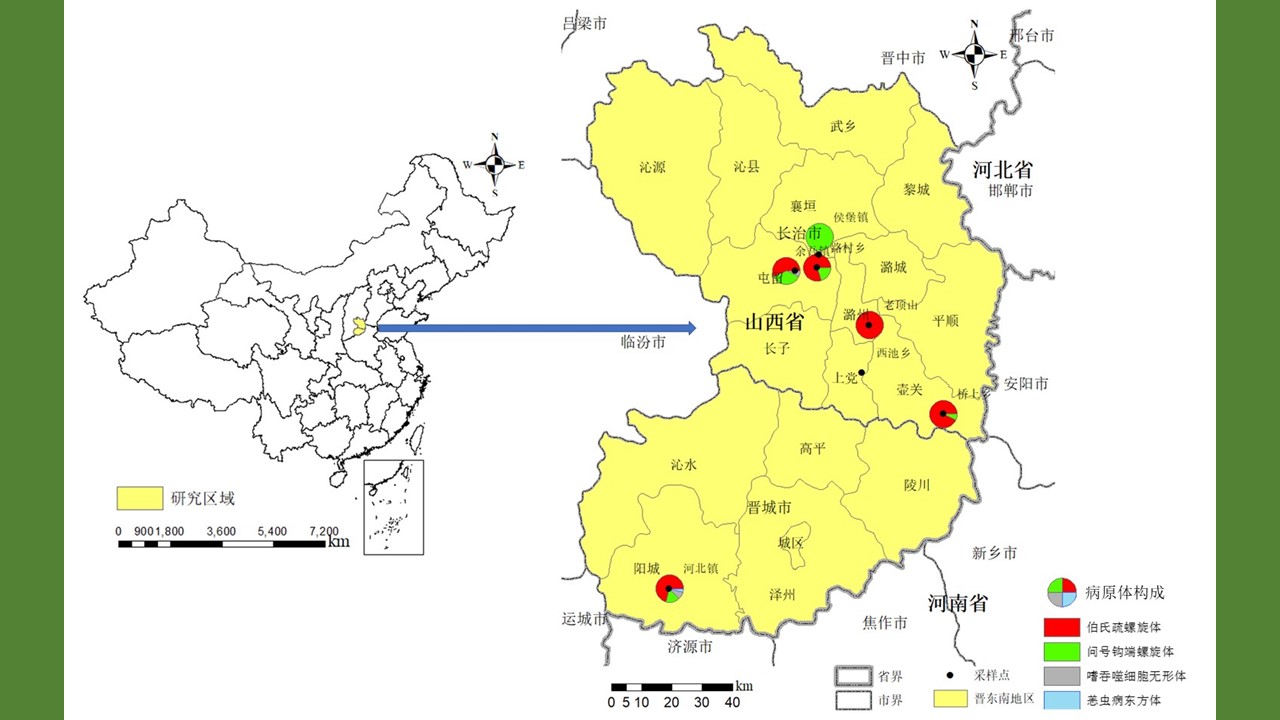
Objective To investigate the prevalence of Borrelia burgdorferi, Leptospira interrogans, Rickettsia typhi, Anaplasma phagocytophilum, Orientia tsutsugamushi, and Francisella tularensis in rodents in the southeast of Shanxi province, China, and to provide a scientific basis for the prevention and control of local natural focal diseases. Methods Seven sampling sites were selected in the southeastern region of Shanxi province in July 2020 and May 2021, and rodents were captured by the night trapping method. The spleen and kidney tissues of rodents were collected under aseptic conditions for detection of the above six pathogens by real-time polymerase chain reaction. The difference in pathogen detection rate among different species, sexes, tissues, and habitats of rodents was analyzed by the χ2 test or Fisher's exact test. Results In total, 248 rodents from 8 species were captured, including Mus musculus, Apodemus agrarius, Niviventer confucianus, Caryomys inez, A. draco, Rattus tanezumi, Cricetulus triton, and A. peninsulae. Except A. peninsulae, four pathogens namely B. burgdorferi, L. interrogans, A. phagocytophilum, and O. tsutsugamushi were detected in the other 7 species of rodents, with detection rates of 21.77% (54/248), 5.24% (13/248), 1.21% (3/248), and 0.40% (1/248), respectively (χ2=200.097, P<0.001). R. typhi and F. tularensis were not detected. The detection rate of B. burgdorferi was the highest in the forest region and was statistical different between different habitats (χ2=17.906, P<0.001). B. burgdorferi was mainly detected in N. confucianus and A. agrarius, with a higher detection rate in kidney tissue than in spleen tissue (χ2=5.310, P=0.021). The detection rate of L. interrogans was the highest in the village, but was comparable between different habitats (Fisher's exact test, P=0.971). L. interrogans was mainly detected in R. tanezumi, with no statistical difference in the detection rate between spleen and kidney tissues (χ2=0.773, P=0.379). In addition, 11 rodents were found to have mixed infection with two pathogens. Conclusion B. burgdorferi and L. interrogans are the main pathogens prevalent in the rodents in southeastern Shanxi, which may have the possibility to cause human diseases. Therefore, corresponding prevention and control measures should be taken into consideration by relevant authorities.
YU Juan, BIAN Xiang, XIE Bing, ZHAO Yong-bo, BI Ge-yue, DU Xia-yan, BI Li-fang, LI Dong-mei, RAO Hua-xiang
. Prevalence of rodent-borne pathogens in the southeast of Shanxi province, China[J]. Chinese Journal of Vector Biology and Control, 2022
, 33(2)
: 211
-215
.
DOI: 10.11853/j.issn.1003.8280.2022.02.008
[1] 栗冬梅, 徐兆楠, 朱彩英, 等. 应用TaqMan探针实时荧光定量PCR法调查北京市部分城郊区鼠传病原体流行状况[J]. 中国媒介生物学及控制杂志, 2019, 30(1):12-17. DOI:10.11853/j.issn.1003.8280.2019.01.003. Li DM, Xu ZN, Zhu CY, et al. An epidemiologic investigation of rodent-borne pathogens in some suburban areas of Beijing, China[J]. Chin J Vector Biol Control, 2019, 30(1):12-17. DOI:10.11853/j.issn.1003.8280.2019.01.003.(in Chinese)
[2] Seifert SN, Khatchikian CE, Zhou W, et al. Evolution and population genomics of the Lyme borreliosis pathogen, Borrelia burgdorferi[J]. Trends Genet, 2015, 31(4):201-207. DOI:10. 1016/j.tig.2015.02.006.
[3] Ismail N, McBride JW. Tick-borne emerging infections:Ehrlichiosis and anaplasmosis[J]. Clin Lab Med, 2017, 37(2):317-340. DOI:10.1016/j.cll.2017.01.006.
[4] Salje J. Orientia tsutsugamushi:A neglected but fascinating obligate intracellular bacterial pathogen[J]. PLoS Pathog, 2017, 13(12):e1006657. DOI:10.1371/journal.ppat.1006657.
[5] Zhang SF, Du J, Mi XM, et al. Rickettsia typhi infection in severe fever with thrombocytopenia patients, China[J]. Emerg Microbes Infect, 2019, 8(1):579-584. DOI:10.1080/22221751.2019. 1599696.
[6] Ma XJ, Gong XQ, Xiao X, et al. Detection of Leptospira interrogans in Hedgehogs from Central China[J]. Vector Borne Zoonotic Dis, 2020, 20(6):427-431. DOI:10.1089/vbz.2019. 2544.
[7] Ramakrishnan G. Iron and virulence in Francisella tularensis[J]. Front Cell Infect Microbiol, 2017, 7:107. DOI:10.3389/fcimb. 2017.00107.
[8] 陈钧. 晋东南地区兽类地理分布[J]. 山西大学学报(自然科学版), 1999, 22(1):102-104. DOI:10.3969/j.issn.0253-2395. 1999.01.023. Chen J. The geography distribution of mammals in Southeast region of Shanxi[J]. J Shanxi Univ(Nat Sci Ed), 1999, 22(1):102-104. DOI:10.3969/j.issn.0253-2395.1999.01.023.(in Chinese)
[9] 赵月明. 山西省鼠传疾病地理区划[J]. 卫生研究, 2001, 30(2):93-97. DOI:10.3969/j.issn.1000-8020.2001.02.015. Zhao YM. Geographical divisions of rat transmissible diseases[J]. J Hyg Res, 2001, 30(2):93-97. DOI:10.3969/j.issn.1000-8020.2001.02.015.(in Chinese)
[10] 刘明社, 武延隽, 赵中夫. 山西长治地区就诊人群莱姆病血清学初步调查[J]. 长治医学院学报, 2006, 20(1):17-18. DOI:10.3969/j.issn.1006-0588.2006.01.008. Liu MS, Wu YJ, Zhao ZF. Investigation on seroepidemiology of lyme disease in Changzhi, Shanxi province[J]. J Changzhi Med Coll, 2006, 20(1):17-18. DOI:10.3969/j.issn.1006-0588.2006. 01.008.(in Chinese)
[11] 耿震, 侯学霞, 张琳, 等. 一种莱姆病螺旋体real-time PCR方法的建立及其在鼠标本检测中的应用评价[J]. 中国人兽共患病学报, 2015, 31(9):812-816. DOI:10.3969/j.issn.1002-2694. 2015.09.006. Geng Z, Hou XX, Zhang L, et al. Evaluation of a new real-time PCR assay for detection of Borrelia burgdorferi in rodents[J]. Chin J Zoonoses, 2015, 31(9):812-816. DOI:10.3969/j.issn.1002-2694.2015.09.006.(in Chinese)
[12] Maurin M. Real-time PCR as a diagnostic tool for bacterial diseases[J]. Expert Rev Mol Diagn, 2012, 12(7):731-754. DOI:10.1586/erm.12.53.
[13] 万康林, 郭衍, 许世锷, 等. 从粤东丰溪自然保护区白腹巨鼠和褐家鼠体内分离出莱姆病螺旋体[J]. 中国媒介生物学及控制杂志, 1999, 10(3):174-175. DOI:10.3969/j.issn.1003-4692. 1999.03.005. Wan KL, Guo Y, Xu SE, et al. Borrelia burgdorferi isolated from Rattus edwardsi and R. norvegicus in Fengxi Protective Natural Region of East Guangdong province[J]. Chin J Vector Biol Control, 1999, 10(3):174-175. DOI:10.3969/j.issn.1003-4692.1999.03.005.(in Chinese)
[14] Rodríguez-Rojas JJ, Rodríguez-Moreno Á, Sánchez-Casas RM, et al. Molecular detection of Leptospira interrogans and Borrelia burgdorferi in wild rodents from Mexico[J]. Vector Borne Zoonotic Dis, 2020, 20(11):860-863. DOI:10.1089/vbz. 2019.2600.
[15] Steere AC, Strle F, Wormser GP, et al. Lyme borreliosis[J]. Nat Rev Dis Primers, 2016, 2:16090. DOI:10.1038/nrdp.2016.90.
[16] 郝琴. 莱姆病的流行现状及防制措施[J]. 中国媒介生物学及控制杂志, 2020, 31(6):639-642. DOI:10.11853/j.issn.1003. 8280.2020.06.002. Hao Q. Epidemic situation and control measures of Lyme disease[J]. Chin J Vector Biol Control, 2020, 31(6):639-642. DOI:10.11853/j.issn.1003.8280.2020.06.002.(in Chinese)
[17] 杨新根, 王庭林, 宁振东, 等.入侵种黄胸鼠(Rattus flavipectus)在山西省的分布特征及发展趋势[J].山西农业科学, 2011, 39(5):462-464.DOI:10.3969/j.issn.1002-2481.2011.05.24. Yang XG, Wang TL, Ning ZD, et al. The distribution characteristics and development tendency of Rattus flavipectus as an invasive species in Shanxi[J]. J Shanxi Agr Sci, 2011, 39(5):462-464. DOI:10.3969/j.issn.1002-2481.2011.05.24.(in Chinese)
[18] Zhang CL, Wang H, Yan J. Leptospirosis prevalence in Chinese populations in the last two decades[J]. Microbes Infect, 2012, 14(4):317-323. DOI:10.1016/j.micinf.2011.11.007.
[19] Telfer S, Lambin X, Birtles R, et al. Species interactions in a parasite community drive infection risk in a wildlife population[J]. Science, 2010, 330(6001):243-246. DOI:10.1126/science. 1190333.

