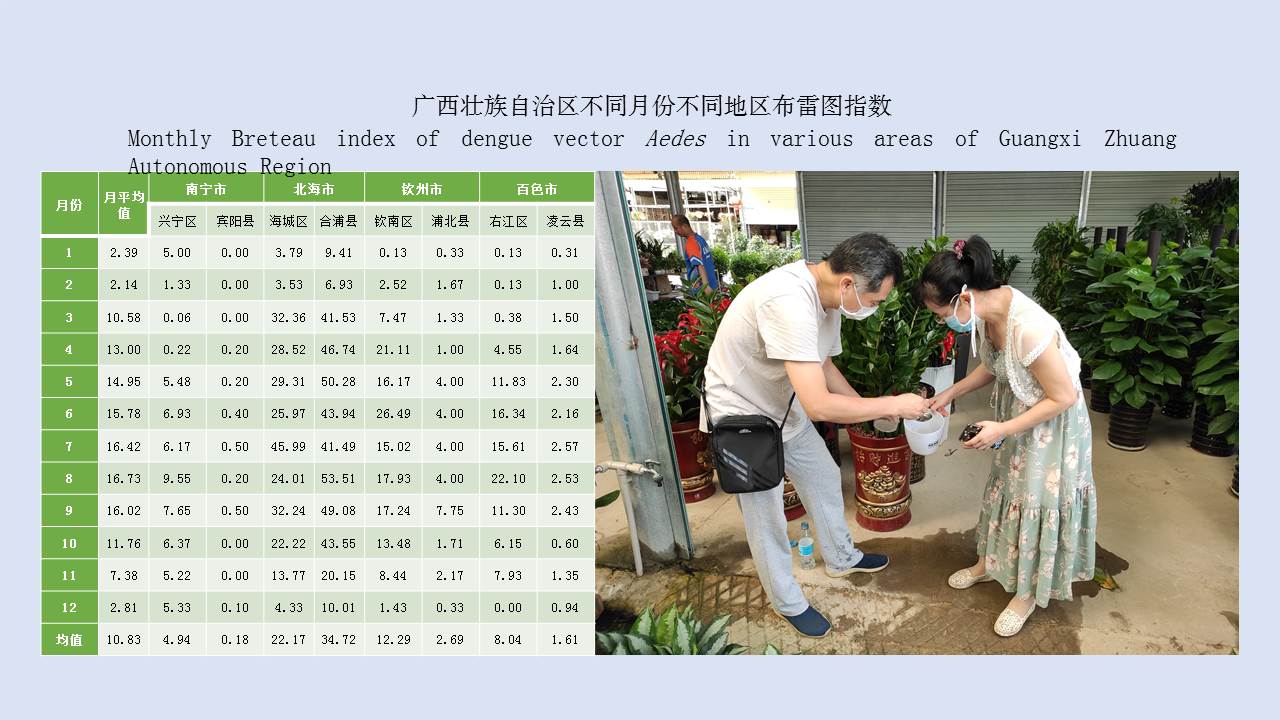
Objective To investigate the dengue vector Aedes density and seasonal fluctuation in Nanning, Beihai, Qinzhou, and Baise, Guangxi Zhuang Autonomous Region, China, and to provide a strong basis for the scientific prevention of dengue fever. Methods According to the "Special investigation of dengue vector Aedes" issued by Chinese Center for Disease Control and Prevention, the Breteau index (BI) method, the mosq-ovitrap index (MOI) method, and the double-layered mosquito net method were used to monitor the density of larval and adult Ae. albopictus mosquitoes in 2020-2021. ArcGIS 10.5 software was used to plot the spatial distribution of surveillance sites of vector Aedes. SPSS 16.0 software and the one-sample t-test were used to perform the statistical analysis. Results In 2020-2021, the overall mean BI, MOI, and net trap index at all surveillance sites were 10.83, 9.39, and 2.04 mosquitoes/net·hour, respectively. According to the statistical analysis, At most surveillance sites, there were statistical differences between BI and the overall mean BI (all P<0.05), between the net trapping index and the overall mean net trap index (all P<0.05). At half of the surveillance sites, there were no statistical difference between MOI and the overall mean MOI (all P>0.05). The BI at all surveillance sites was higher than 5.00 from March to November, and reached the peak value (16.73) in August. The MOI at all surveillance sites was higher than 5.00 from April to October, and reached the peak value (20.86) in July. The net trap index at all surveillance sites was higher than 2.00 mosquitoes/net·hour from May to September, and reached the peak value (4.57 mosquitoes/net·hour) in July. Conclusion The density of Aedes mosquitoes in Guangxi Zhuang Autonomous Region is at a relatively high level. The results suggested it is urgent to carry out the prevention and control of adult Aedes mosquitoes from July to August and the breeding sites cleaning of Aedes larvae from August to September, so as to control the mosquito density below the safety threshold and reduce the risk of dengue outbreak.
[1] Benedict MQ,Levine RS,Hawley WA,et al. Spread of the tiger:Global risk of invasion by the mosquito Aedes albopictus[J]. Vector Borne Zoonotic Dis,2007,7(1):76-85. DOI:10.1089/vbz.2006.0562.
[2] 刘起勇. 我国登革热流行新趋势、防控挑战及策略分析[J]. 中国媒介生物学及控制杂志,2020,31(1):1-6. DOI:10.11853/j.issn.1003.8280.2020.01.001. Liu QY. Dengue fever in China:new epidemical trend,challenges and strategies for prevention and control[J]. Chin J Vector Biol Control,2020,31(1):1-6. DOI:10.11853/j.issn.1003.8280. 2020.01.001.(in Chinese)
[3] 赵峥,李昱,牟笛,等. 2016-2018年中国重点省份境外输入性登革热病例的时空分析[J]. 中华流行病学杂志,2020,41(11):1808-1812. DOI:10.3760/cma.j.cn112338-20191231-00923. Zhao Z,Li Y,Mou D,et al. Spatial-temporal analysis on imported dengue fever in six provinces of China,2016-2018[J]. Chin J Epidemiol,2020,41(11):1808-1812. DOI:10.3760/cma.j.cn112338-20191231-00923.(in Chinese)
[4] 岳玉娟,任东升,刘小波,等. 2014-2018年中国登革热病例空间特征及相关关系研究[J]. 中国媒介生物学及控制杂志,2020,31(5):517-520. DOI:10.11853/j.issn.1003.8280.2020. 05.003. Yue YJ,Ren DS,Liu XB,et al. A study on spatial characteristics and correlations of different types of dengue cases in mainland China,2014-2018[J]. Chin J Vector Biol Control,2020,31(5):517-520. DOI:10.11853/j.issn.1003.8280.2020.05.003.(in Chinese)
[5] 欧阳颐,唐小兰,廖宁,等. 广西登革热传播媒介伊蚊防控策略探讨[J]. 中华卫生杀虫药械,2020,26(5):486-488. DOI:10.19821/j.1671-2781.2020.05.024. Ouyang Y,Tang XL,Liao N,et al. Discussion on the strategy for controlling mosquito vector of dengue in Guangxi Zhuang Autonomous Region[J]. Chin J Hyg Insect Equip,2020,26(5):486-488. DOI:10.19821/j.1671-2781.2020.05.024.(in Chinese)
[6] 侯凌欣,鞠翰,展鹏,等. 抗登革病毒药物化学研究新进展[J]. 药学学报,2020,55(4):669-678. DOI:10.16438/j.0513-4870.2019-0787. Hou LX,Ju H,Zhan P,et al. Recent advances in the discovery of dengue virus inhibitors[J]. Acta Pharm Sin,2020,55(4):669-678. DOI:10.16438/j.0513-4870.2019-0787.(in Chinese)
[7] 郭泽强,梁长威,屈志强,等. 广西伊蚊监测情况综述[J]. 医学动物防制,2020,36(4):343-345. DOI:10.7629/yxdwfz202004012. Guo ZQ,Liang CW,Qu ZQ,et al. A review of Aedes surveillance in Guangxi[J]. J Med Pest Control,2020,36(4):343-345. DOI:10.7629/yxdwfz202004012.(in Chinese)
[8] 刘小波,吴海霞,郭玉红,等. 2019年全国媒介伊蚊监测报告[J]. 中国媒介生物学及控制杂志,2020,31(4):401-406. DOI:10.11853/j.issn.1003.8280.2020.04.004. Liu XB,Wu HX,Guo YH,et al. Annual report on Aedes vector surveillance in China,2019[J]. Chin J Vector Biol Control,2020,31(4):401-406. DOI:10.11853/j.issn.1003.8280.2020. 04.004.(in Chinese)
[9] 孟凤霞,王义冠,冯磊,等. 我国登革热疫情防控与媒介伊蚊的综合治理[J]. 中国媒介生物学及控制杂志,2015,26(1):4-10. DOI:10.11853/j.issn.1003.4692.2015.01.002. Meng FX,Wang YG,Feng L,et al. Review on dengue prevention and control and integrated mosquito management in China[J]. Chin J Vector Biol Control,2015,26(1):4-10. DOI:10.11853/j.issn.1003.4692.2015.01.002.(in Chinese)
[10] 李妍君,陆甲,李艳兰,等. 2020年广西气候概况[J]. 气象研究与应用,2021,42(2):100-104. DOI:10.19849/j.cnki.CN45-1356/P.2021.2.19. Li YJ,Lu J,Li YL,et al. Climate survey of Guangxi in 2020[J]. J Met Research Appl,2021,42(2):100-104. DOI:10.19849/j.cnki.CN45-1356/P.2021.2.19.(in Chinese)
[11] 蔡小双. 温度、相对湿度和光照度对白纹伊蚊生物学参数的影响研究[D]. 广州:暨南大学,2020. Cai XS. A study on the effect of temperature,relative humidity and illuminance on the entomological parameters of Aedes albopictus[D]. Guangzhou:Ji'nan University,2020. (in Chinese)
[12] 王丕玉,董利民,朱国君. 致倦库蚊、白纹伊蚊实验室生活史比较观察[J]. 医学动物防制,2003,19(12):730-731. DOI:10.3969/j.issn.1003-6245.2003.12.014. Wang PY,Dong LM,Zhu GJ. Comparative observation on laboratory life history of Culex pipiens quinquefasciatus and Aedes albopictus[J]. Chin J Pest Control,2003,19(12):730-731. DOI:10.3969/j.issn.1003-6245.2003.12.014.(in Chinese)
[13] 卢耀状,吕忠其,廖克昌,等. 南宁市2014年登革热流行特征及防控效果[J]. 中国热带医学,2015,15(5):578-580. DOI:10.13604/j.cnki.46-1064/r.2015.05.018. Lu YZ,Lyu ZQ,Liao KC,et al. Epidemic features and control effect of dengue fever in Nanning in 2014[J]. China Trop Med,2015,15(5):578-580. DOI:10.13604/j.cnki.46-1064/r.2015.05.018.(in Chinese)
[14] 廖毓香,梁柱石,罗景贤,等. 2020年广西岑溪市308例登革热患者临床特征分析[J]. 传染病信息,2021,34(5):438-442. DOI:10.3969/j.issn.1007-8134.2021.05.012. Liao YX,Liang ZS,Luo JX,et al. Clinical characteristics analysis of 308 patients with dengue fever in Cenxi city of Guangxi[J]. Infect Dis Inform,2021,34(5):438-442. DOI:10.3969/j.issn. 1007-8134.2021.05.012.(in Chinese)

