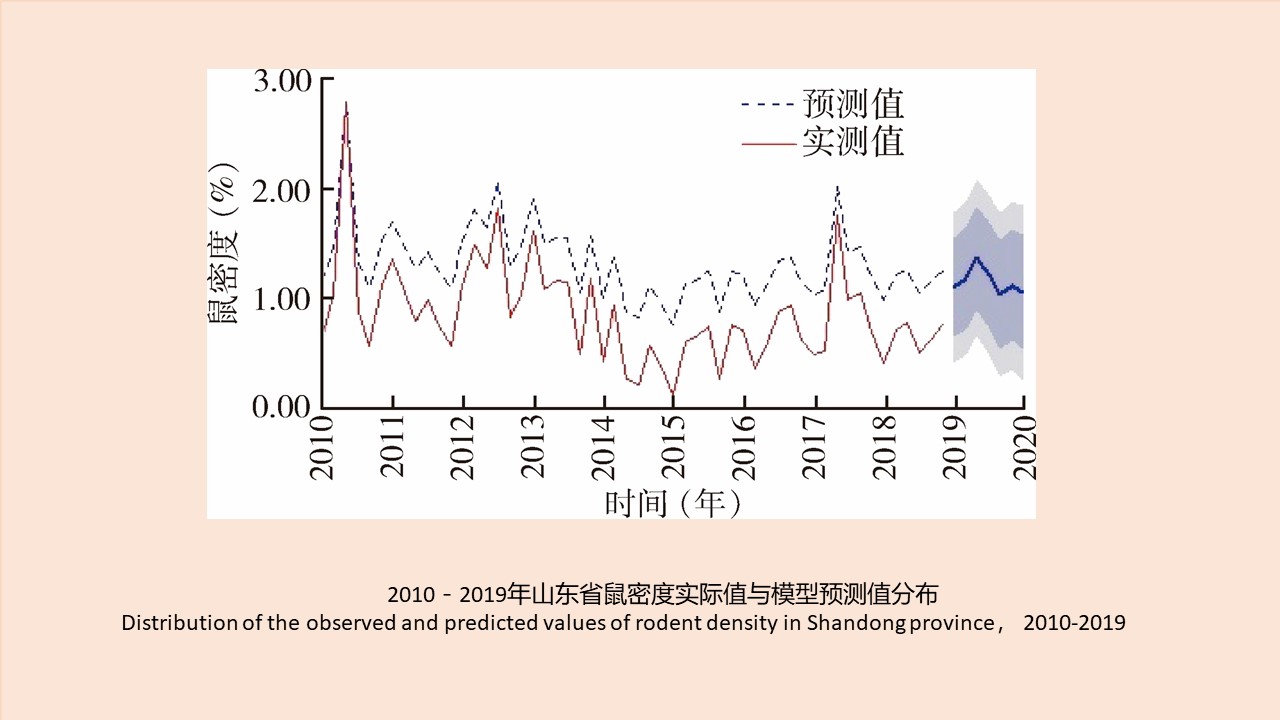
Objective To investigate the density of rodents at the national surveillance sites (Ji'nan, Qingdao, and Liaocheng) in Shandong province of China and to discuss the application of autoregressive integrated moving average (ARIMA) model in rodent density prediction and warning. Methods The night trap/cage method was used to monitor the density of rodents, and R 3.6.2 software was used to establish the ARIMA model for rodent density data in each monitoring month from 2010 to 2018. The predicted rodent density was compared with the actual rodent density in each monitoring month in 2019 to evaluate the prediction effect of the model. Results The average rodent density was 0.80% at the national surveillance sites in Shandong province in 2010-2018. The ARIMA model was used for the fitting of rodent density at the national surveillance sites in Shandong province in 2010-2018. With ARIMA (0,1,1)×(0,1,1)6 as the optimal model and white noise sequence as the residual sequence (χ2=0.035, P=0.832), this model was used to predict rodent density in each monitoring month of 2019, and the actual monitoring values fell within the 95% confidence interval of the predicted values. The seasonal variation trend of rodent density was basically consistent with the observed value, suggesting that the model could be used to predict rodent density in the short and medium term. Conclusion The ARIMA (0,1,1)×(0,1,1)6 model is well fitted with rodent density at the national surveillance sites in Shandong province and can be used for the prediction and early warning of rodent density, so as to provide a basis for the prevention and control of rodent-borne diseases.
[1] Meerburg BG,Singleton GR,Kijlstra A. Rodent-borne diseases and their risks for public health[J]. Crit Rev Microbiol,2009,35(3):221-270. DOI:10.1080/10408410902989837.
[2] Li Q,Guo NN,Han ZY,et al. Application of an autoregressive integrated moving average model for predicting the incidence of hemorrhagic fever with renal syndrome[J]. Am J Trop Med Hyg,2012,87(2):364-370. DOI:10.4269/ajtmh.2012.11-0472.
[3] 中华人民共和国卫生部. 全国病媒生物监测方案(试行)[Z]. 北京:中国疾病预防控制中心,2005. Ministry of Health of the People's Republic of China. National vector surveillance program (Trial)[Z]. Beijing:Chinese Center for Disease Control and Prevention,2005.
[4] 中华人民共和国卫生和计划生育委员会. 全国病媒生物监测方案[Z]. 北京:中国疾病预防控制中心,2016. The People's Republic of China Health and Family Planning Commission. National vector surveillance program[Z]. Beijing:Chinese Center for Disease Control and Prevention,2016.
[5] 王燕. 应用时间序列分析[M]. 北京:中国人民大学出版社,2015:83-106. Wang Y. Applying time series analysis[M]. Beijing:Renmin University of China Press,2015:83-106.
[6] 田庆,刘永鹏,张晶晶,等. ARIMA乘积季节模型在山东省肺结核发病预测中的应用[J]. 山东大学学报(医学版),2021,59(7):112-118.DOI:10.6040/j.issn.1671-7554.0.2021.0049. Tian Q,Liu YP,Zhang JJ,et al. Application of ARIMA multiplicative seasonal model in the prediction of pulmonary tuberculosis incidence in Shandong province[J]. J Shandong Univ(Health Sci),2021,59(7):112-118. DOI:10.6040/j.issn. 1671-7554.0.2021.0049.
[7] 言晨绮,王瑞白,刘海灿,等. ARIMA模型预测2018-2019年我国肺结核发病趋势的应用[J]. 中华流行病学杂志,2019,40(6):633-637. DOl:10.3760/cma.j.issn.0254-6450.2019.06.006. Yan CQ,Wang RB,Liu HC,et al. Application of ARIMA model in predicting the incidence of tuberculosis in China from 2018 to 2019[J]. Chin J Epid,2019,40(6):633-637. DOI:10.3760/cma.j.issn.0254-6450.2019.06.006.
[8] 高文,黄钢,马丽华,等. 差分自回归移动平均模型在河北省鼠密度监测信息系统中的应用研究[J]. 中国媒介生物学及控制杂志,2017,28(3):265-268. DOI:10.11853/j.issn.1003. 8280.2017.03.018. Gao W,Huang G,Ma LH,et al. Application of autoregressive integrated moving average (ARIMA) model in information system for rodent surveillance in Hebei province[J]. Chin J Vector Biol Control,2017,28(3):265-268. DOI:10.11853/j.issn.1003.8280.2017.03.018.
[9] 王永斌,郑瑶,柴峰,等. 基于周期分解的ARIMA模型在甲肝发病率预测中的应用[J]. 现代预防医学,2015,42(23):4225-4229. Wang YB,Zheng Y,Chai F,et al. Application of ARIMA model based on seasonal decomposition in prediction on incidence of Hepatitis A,China[J]. Mod Prev Med,2015,42(23):4225-4229.
[10] 运玲,王福才,张秋芬,等. ARIMA模型在德国小蠊密度季节消长预测中应用及抗药性[J]. 中国公共卫生,2020,36(3):410-415. DOI:10.11847/zgggws1124086. Yun L,Wang FC,Zhang QF,et al. Prediction of seasonal density fluctuation with autoregressive integrated moving average model and determination of pesticide resistance in Blattella germanica[J]. Chin J Public Health,2020,36(3):410-415. DOI:10. 11847/zgggws1124086.
[11] 傅伟杰,谢昀,曾志笠,等. 三种模型在江西省流感样病例预测中的应用与比较[J]. 中华疾病控制杂志,2019,23(1):101-105. DOI:10.16462/j.cnki.zhjbkz.2019.01.021. Fu WJ,Xie Y,Zeng ZL,et al. Application and comparison of three models for the prediction of influenza-like illness in Jiangxi province[J]. Chin J Dis Control,2019,23(1):101-105. DOI:10.16462/j.cnki.zhjbkz.2019.01.021.
[12] 肖珊,陈立章,龙建勋,等. 基于R语言自回归积分移动平均模型在长沙市三带喙库蚊密度预测中的应用[J]. 医学动物防制,2020,36(3):278-281. DOI:10.7629/yxdwfz202003021. Xiao S,Chen LZ,Long JX,et al. Application of R-based autoregressive integrated moving average model in the prediction of Culex tritaeniorhynchus density in Changsha city[J]. J Med Pest Control,2020,36(3):278-281. DOI:10.7629/yxdwfz 202003021.
[13] 潘欢弘,朱蒙曼,刘晓青. ARIMA乘积季节模型在江西省手足口病发病预测中的应用[J]. 现代预防医学,2018,45(1):1-4,7. Pan HH,Zhu MM,Liu XQ. Application of ARIMA product seasonal model in the incidence prediction of hand, foot and mouth disease,Jiangxi[J]. Mod Prev Med,2018,45(1):1-4,7.
[14] 张家勇,丁俊,白玉银,等. 辽宁省2006-2015年鼠类密度及种群结构分析[J]. 中国媒介生物学及控制杂志,2017,28(1):51-55. DOI:10.11853/j.issn.1003.8280.2017.01.014. Zhang JY,Ding J,Bai YY,et al. Analysis of rodent density and population structure in Liaoning province from 2006 to 2015[J]. Chin J Vector Biol Control,2017,28(1):51-55. DOI:10.11853/j.issn.1003.8280.2017.01.014.
[15] 吴瑜燕,龚震宇,侯娟,等. 浙江省2011-2013年病媒生物监测结果分析[J]. 中国媒介生物学及控制杂志,2015,26(4):394-397. DOI:10.11853/j.issn.1003.4692.2015.04.017. Wu YY,Gong ZY,Hou J,et al. Analysis of vector surveillance from 2011 to 2013 in Zhejiang province,China[J]. Chin J Vector Biol Control,2015,26(4):394-397. DOI:10.11853/j.issn. 1003.4692.2015.04.017.
[16] 桂腾叶,陈硕,隗立志,等. 基于ARIMA的传染病流行趋势预测及防治对策[J]. 电子科技,2015,28(12):48-51. DOI:10.16180/j.cnki.issn1007-7820.2015.12.013. Gui TY,Chen S,Kui LZ,et al. Prediction and countermeasures of infectious diseases based on ARIMA[J]. Electron Sci Tech,2015,28(12):48-51. DOI:10.16180/j.cnki.issn1007-7820. 2015.12.013.

