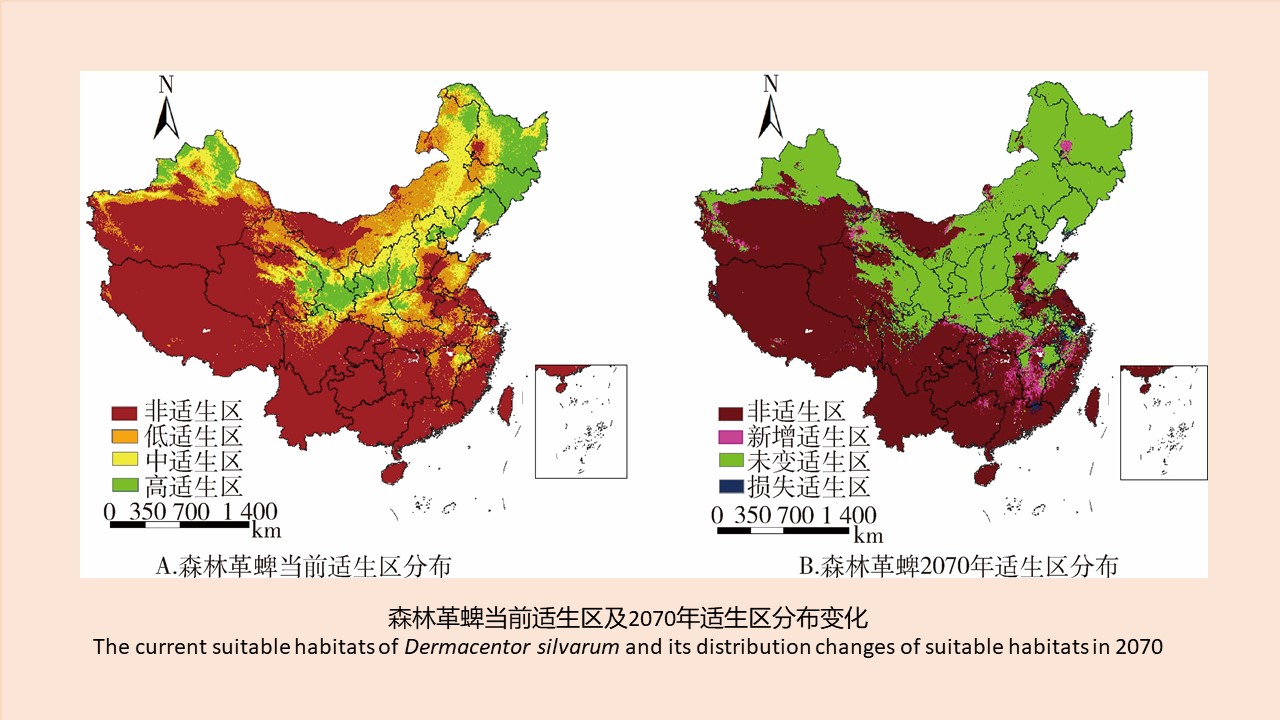
Objective To analyze the climatic and environmental factors that affect the distribution of Dermacentor silvarum in China and the potentially suitable habitats of D. silvarum, and to project the impact of climate changes on the distribution of D. silvarum in China. Methods The geographical distribution of D. silvarum in China was searched, and the coordinate information of distribution points was extracted.Maximum entropy model was used to project the potentially suitable habitats of D. silvarum in China. Results Among the climatic and environmental factors, altitude (21.6%), precipitation of coldest quarter (16.7%), mean temperature of driest quarter (15.4%), and annual mean temperature (12.3%) had great influence on the distribution of D. silvarum in China. D. silvarum was mainly distributed in the north of China, especially in Inner Mongolia Autonomous Region and northeast China. Under the representative concentration pathway 4.5 scenario, the suitable area of D. silvarum in China will increase by 104 thousand square kilometers by 2070, and the new suitable areas are mainly located in Hunan, Qinghai, Jiangxi, and Zhejiang provinces. Conclusion Altitude may be the main factors affecting the distribution of D. silvarum, and the distribution range of D. silvarum will be expanded in future climate scenarioes.
LIU Kai, YAO Xiao-yan, CUN De-jiao, ZHANG Yi, LI Lan-hua
. Effects of climatic and environmental factors on the potential geographic distribution of Dermacentor silvarum in China[J]. Chinese Journal of Vector Biology and Control, 2021
, 32(6)
: 732
-735
.
DOI: 10.11853/j.issn.1003.8280.2021.06.015
[1] 刘宇婷,黄雪玲,张汉林,等. 黑龙江省风景区及其周边区域蜱的调查[J]. 现代畜牧科技,2016(4):25-26. DOI:10.3969/j.issn.1673-1921.2016.04.016. Liu YT,Huang XL,Zhang HL,et al. Investigation of ticks in Heilongjiang scenic area and its surrounding areas[J]. Mod Anim Husb Sci Technol,2016(4):25-26. DOI:10.3969/j.issn. 1673-1921.2016.04.016.
[2] 巴音查汗,岳城,黄燕,等. 实验条件下森林革蜱生活史观察[J]. 地方病通报,2001,16(2):74-77. DOI:10.3969/j.issn. 1000-3711.2001.02.029. Bayinchahan,Yue C,Huang Y,et al. Observation on the life history of Dermacentor silvarum under the condition of experiment[J]. Endem Dis Bull,2001,16(2):74-77. DOI:10.3969/j.issn. 1000-3711.2001.02.029.
[3] 代玉烜,金瑭,徐海霞,等. 基于MaxEnt模型的小黄花茶在中国的适生区域研究[J]. 四川大学学报(自然科学版),2021,58(2):026002. DOI:10.19907/j.0490-6756.2021.026002. Dai YX,Jin T,Xu HX,et al. Study on the suitable area of Camellia luteoflora Y. K. Li in China based on MaxEnt model[J]. J Sichuan Univ(Nat Sci Ed),2021,58(2):026002. DOI:10.19907/j.0490-6756.2021.026002.
[4] 古丽米拉·克孜尔别克,邱琴,海拉提·克孜尔别克. 基于MaxEnt模型的阿勒泰金莲花潜在适生区预测[J]. 江苏农业科学,2021,49(4):82-87. DOI:10.15889/j.issn.1002-1302.2021. 04.016. Kezierbieke GLML,Qiu Q,Kezierbieke HLT. Prediction of potential suitable area of Trollius altaicus based on MaxEnt model[J]. Jiangsu Agric Sci,2021,49(4):82-87. DOI:10.15889/j.issn.1002-1302.2021.04.016.
[5] Escobar LE,Lira-Noriega A,Medina-Vogel G,et al. Potential for spread of the white-nose fungus (Pseudogymnoascus destructans) in the Americas:use of MaxEnt and NicheA to assure strict model transference[J]. Geospat Health,2014,9(1):221-229. DOI:10.4081/gh.2014.19.
[6] 陈智强,赵增辉,王远飞,等. 基于红外相机技术和MaxEnt模型的黑麂(Muntiacus crinifrons)活动节律分析和潜在适生区预测[J]. 生态学报,2021,41(9):3535-3547. DOI:10.5846/stxb201906041185. Chen ZQ,Zhao ZH,Wang YF,et al. Analysis of activity rhythm and prediction of potential suitable distribution of black muntjac (Muntiacus crinifrons) based on the ITCT and MaxEnt model[J]. Acta Ecol Sin,2021,41(9):3535-3547. DOI:10.5846/stxb201906041185.
[7] 辜云杰,李晓清,杨汉波. 基于MaxEnt生态位模型预测桢楠在中国的潜在适宜栽培区[J]. 西北林学院学报,2021,36(2):136-141. DOI:10.3969/j.issn.1001-7461.2021.02.20. Gu YJ,Li XQ,Yang HB. MaxEnt model-based prediction of suitable cultivation area of Phoebe zhennan in China[J]. J Northwest For Univ,2021,36(2):136-141. DOI:10.3969/j.issn. 1001-7461.2021.02.20.
[8] 吴瑞婵,甘淑,于丽君,等. 最大熵模型的巴基斯坦遗址预测分布研究[J]. 测绘科学,2021,46(3):96-103. DOI:10.16251/j.cnki.1009-2307.2021.03.015. Wu RC,Gan S,Yu LJ,et al. The study of predictive distribution of Pakistani sites based on MaxEnt model[J]. Sci Surv Mapp,2021,46(3):96-103. DOI:10.16251/j.cnki.1009-2307.2021.03.015.
[9] 张蕾,黄大鹏,杨冰韵. RCP 4.5情景下中国人口对高温暴露度预估研究[J]. 地理研究,2016,35(12):2238-2248. DOI:10.11821/dlyj201612004. Zhang L,Huang DP,Yang BY. Future population exposure to high temperature in China under RCP 4.5 scenario[J]. Geogr Res,2016,35(12):2238-2248. DOI:10.11821/dlyj201612004.
[10] 赵国平. 中国蜱类空间分布及其危害预测[D]. 北京:中国人民解放军军事科学院,2018. Zhao GP. Spatial distribution of ticks and their hazard prediction in China[D]. Beijing:Academy of Military Science of Chinese People's Liberation Army,2018.
[11] Pukhovskaya NM,Morozova OV,Vysochina NP,et al. Prevalence of Borrelia burgdorferi sensu lato and B. miyamotoi in ixodid ticks in the Far East of Russia[J]. Int J Parasitol Parasit Wildl,2019,8:192-202. DOI:10.1016/j.ijppaw.2019.01.005.
[12] Gaye M,Amanzougaghene N,Laidoudi Y,et al. Hymenopteran parasitoids of hard ticks in western Africa and the Russian far east[J]. Microorganisms,2020,8(12):1992. DOI:10.3390/microorganisms8121992.
[13] Rubel F,Brugger K,Belova OA,et al. Vectors of disease at the northern distribution limit of the genus Dermacentor in Eurasia:D. reticulatus and D. silvarum[J]. Exp Appl Acarol,2020,82(1):95-123. DOI:10.1007/s10493-020-00533-y.
[14] 姚文炳,陈国定. 森林革蜱生活史与温、湿度的关系[J]. 昆虫学报,1981,24(2):233-236. DOI:10.16380/j.kcxb.1981.02.022. Yao WB,Chen GD. Duration of the life-history of Dermacentor silvarum olenev. (acari:ixodidae) under different temperatures and humidities[J]. Acta Entomol Sin,1981,24(2):233-236. DOI:10.16380/j.kcxb.1981.02.022.
[15] Hong CP,Zhang Q,Zhang Y,et al. Impacts of climate change on future air quality and human health in China[J]. Proc Natl Acad Sci USA,2019,116(35):17193-17200. DOI:10.1073/pnas. 1812881116.

