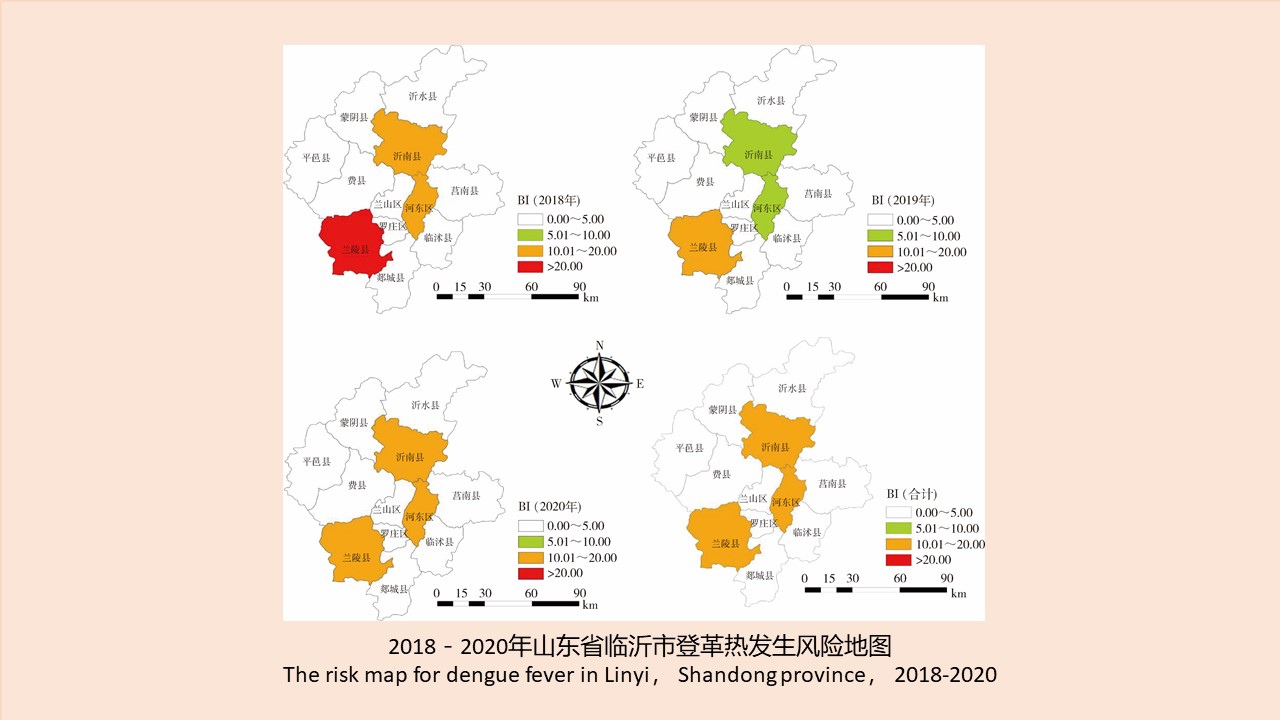
Objective To investigate the density and seasonal variation of Aedes albopictus larvae in Linyi, Shandong province, China and assess the transmission risk of dengue fever, and to prevent the occurrence and epidemic of dengue fever. Methods The Breteau index (BI) was adopted to monitor Ae. albopictus larvae. SPSS 20.0 software was used for statistical analysis, and Chi-squared test was used for comparison of categorical data. Results The BI values of Ae. albopictus larvae were 18.97, 10.79, and 13.88 from 2018 to 2020, respectively, with a mean value of 14.98. The mean BI was higher in Lanling county than in Hedong district and Yinan county. In the three years, the mean BI of households and waste collection stations was 33.03 and 27.00, respectively, indicating a regional epidemic risk of dengue fever; the mean BI in residential areas was 14.36, indicating an outbreak risk of dengue fever; the mean BI of construction sites and parks were 9.31 and 9.27, respectively, indicating a risk of transmission; the mean BI was 4.33 in hospitals, suggesting no risk of dengue fever. The positive rate of mosquito larvae in total water containers was 21.72%, and the waste tires had the highest positive rate of 40.34%. The BI of Ae. albopictus larvae peaked at 54.63 in August 2018, at 40.00 in August 2019, and at 47.51 in July 2020. There was a high regional epidemic risk of dengue fever from June to August, a transmission risk in May, September, and October, and no risk in March, April, and November. Conclusion There is a high density of Ae. albopictus mosquitoes in Linyi, indicating an outbreak or regional epidemic risk of dengue fever. Aedes surveillance and risk control should be strengthened.
XUE Hai-bin, MENG Jin-xia, REN Le, JING Xiao
. Larval Aedes albopictus mosquito surveillance and risk assessment in Linyi, Shandong province, China, 2018-2020[J]. Chinese Journal of Vector Biology and Control, 2021
, 32(6)
: 686
-690
.
DOI: 10.11853/j.issn.1003.8280.2021.06.006
[1] 刘起勇. 我国登革热流行新趋势、防控挑战及策略分析[J]. 中国媒介生物学及控制杂志,2020,31(1):1-6. DOI:10.11853/j.issn.1003.8280.2020.01.001. Liu QY. Dengue fever in China:new epidemical trend,challenges and strategies for prevention and control[J]. Chin J Vector Biol Control,2020,31(1):1-6. DOI:10.11853/j.issn.1003.8280. 2020.01.001.
[2] 景晓,康殿民,王学军. 蚊媒传染病监测技术及应用[M]. 济南:山东人民出版社,2017:702-763. Jing X,Kang DM,Wang XJ. Monitoring technologies and their application of mosquito borne infectious diseases[M]. Ji'nan:Shandong People's Publishing House,2017:702-763.
[3] 李秀春,张书岭. 关于梁山县一起输入性登革热疫情的调查处置分析[J]. 中国卫生产业,2018,15(30):146-147. DOI:10.16659/j.cnki.1672-5654.2018.30.146. Li XC,Zhang SL. Investigation and analysis of an imported dengue fever outbreak in Liangshan county[J]. China Health Indust,2018,15(30):146-147. DOI:10.16659/j.cnki.1672-5654.2018.30.146.
[4] 张伟涛,郝学安. 关于济宁市嘉祥县一起输入性登革热疫情的调查报告[J]. 国际感染病学(电子版),2018,7(4):165-166. Zhang WT,Hao XA. Investigation of an imported dengue fever outbreak in Jiaxiang county[J]. Infect Internat (Electronic Ed),2018,7(4):165-166.
[5] 王杰刚,景晓. 基于德尔菲法评估日照市蚊媒传染病流行风险[J]. 中华卫生杀虫药械,2016,22(5):466-469,473. DOI:10.19821/j.1671-2781.2016.05.016. Wang JG,Jing X. Risk assessment of mosquito-borne diseases in Rizhao city based on Delphi method[J]. Chin J Hyg Insect Equip,2016,22(5):466-469,473. DOI:10.19821/j.1671-2781. 2016.05.016.
[6] 孟凤霞,王义冠,冯磊,等. 我国登革热疫情防控与媒介伊蚊的综合治理[J]. 中国媒介生物学及控制杂志,2015,26(1):4-10. DOI:10.11853/j.issn.1003.4692.2015.01.002. Meng FX,Wang YG,Feng L,et al. Review on dengue prevention and control and integrated mosquito management in China[J]. Chin J Vector Biol Control,2015,26(1):4-10. DOI:10.11853/j.issn.1003.4692.2015.01.002.
[7] 王东,王永明,张晓,等. 济南市白纹伊蚊幼虫密度与登革热风险评估的探讨[J]. 中华卫生杀虫药械,2016,22(5):463-465. DOI:10.19821/j.1671-2781.2016.05.015. Wang D,Wang YM,Zhang X,et al. Investigation and discussion of dengue transmission vector Aedes albopictus in Ji'nan city[J]. Chin J Hyg Insect Equip,2016,22(5):463-465. DOI:10.19821/j.1671-2781.2016.05.015.
[8] 陆宝麟. 我国蚊媒研究最近进展[J]. 中国媒介生物学及控制杂志,2001,12(2):81-84. DOI:10.3969/j.issn.1003-4692.2001. 02.001. Lu BL. Recent progress in research on mosquito vectors in China[J]. Chin J Vector Biol Control,2001,12(2):81-84. DOI:10. 3969/j.issn.1003-4692.2001.02.001.
[9] 高强,曹晖,张振东,等. 白纹伊蚊在上海城区地面雨水井的孳生状况分析[J]. 中华卫生杀虫药械,2016,22(6):563-568. DOI:10.19821/j.1671-2781.2016.06.013. Gao Q,Cao H,Zhang ZD,et al. Breeding status of Aedes albopictus in rain-water catch basins in downtown of Shanghai[J]. Chin J Hyg Insect Equip,2016,22(6):563-568. DOI:10.19821/j.1671-2781.2016.06.013.
[10] 江毅民,严子锵,胡志刚,等. 广州地区农村登革热旧疫点白纹伊蚊密度消长特点分析[J]. 热带医学杂志,2012,12(2):222-223. Jiang YM,Yan ZQ,Hu ZG,et al. Analysis of Aedes albopictus density dynamics in previous dengue fever epidemic focus in Guangzhou rural area[J]. J Trop Med,2012,12(2):222-223.
[11] 景晓,辛正,张世水. 山东地区蚊虫管理概论[M]. 长春:吉林科学技术出版社,2005:150-163. Jing X,Xin Z,Zhang SS. Introduction to mosquito management in Shandong[M]. Changchun:Jilin Science and Technology Press,2005:150-163.
[12] 刘华,曲建强,王学军,等. 2种监测方法在登革热媒介监测中的应用效果评价[J]. 中华卫生杀虫药械,2018,24(3):243-246. DOI:10.19821/j.1671-2781.2018.03.008. Liu H,Qu JQ,Wang XJ,et al. Evaluation of the application effect of two monitoring methods in dengue media monitoring[J]. Chin J Hyg Insect Equip,2018,24(3):243-246. DOI:10.19821/j.1671-2781.2018.03.008.

