

ISSN 1003-8280 CN 10-1522/R 中国疾病预防控制中心 主办
Chinese Journal of Vector Biology and Control >
Anopheles vector control strategy and technology for eliminating the malaria in China
Received date: 2021-07-27
Online published: 2021-10-20
Supported by
Supported by the Bill and Melinda Gates Foundation Project (No. INV-019124)
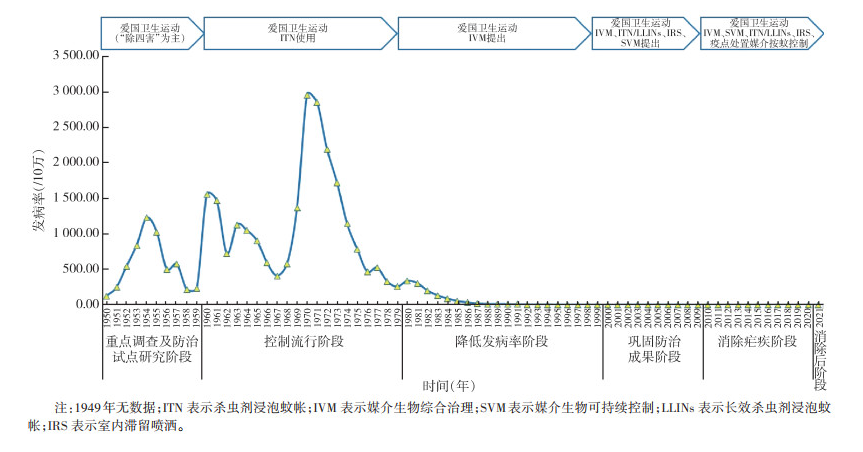
Malaria is a major vector-borne disease transmitted by the bite of Anopheles mosquito,which has caused a heavy disease, economical and social burden to China. After long-term effective malaria control and elimination actions,China was officially granted a malaria-free certification by the World Health Organization (WHO) in June 30, 2021. From "Eliminate the four pests to prevent diseases" initiated by the Patriotic Health Campaign Committee in the early years of the founding of the people’s Republic of China,to the integrated mosquito management strategy in the 1980s, to the sustainable vector management proposed in 2004,and then to Anopheles control of the epidemic spot in the stage of malaria elimination,the Anopheles control strategies and techniques in China have been evolved and innovated with stratified sustainable Anopheles control in the past 70 years,which has played a key role in malaria elimination in China. At present,there are still severe challenges and great pressure in controlling the risk of re-transmission caused by malaria importation and maintaining the malaria-free in China. It is necessary to continue to carry out sustainable control of Anopheles in China,and share the stratified sustainable Anopheles control strategies and practical experience for actively participating in the global action to eliminate malaria,so as to contribute Chinese efforts to realizing the vision of a Malaria-Free world and a community of common health for mankind.
Key words: Malaria elimination; Anopheles vector; Control; Strategy; Technique
LIU Qi-yong, LIU Xiao-bo . Anopheles vector control strategy and technology for eliminating the malaria in China[J]. Chinese Journal of Vector Biology and Control, 2021 , 32(5) : 513 -518 . DOI: 10.11853/j.issn.1003.8280.2021.05.002
[1] Zhai X,Wang QJ,Li M. Tu Youyou's Nobel Prize and the academic evaluation system in China[J]. Lancet,2016,387(10029):1722. DOI:10.1016/S0140-6736(16)30261-6.
[2] Zhou XN. China declared malaria-free:a milestone in the world malaria eradication and Chinese public health[J]. Infect Dis Poverty,2021,10(1):98. DOI:10.1186/s40249-021-00882-9.
[3] 刘起勇,刘小波. 媒介按蚊防控:中国疟疾消除的关键措施[J]. 中国媒介生物学及控制杂志,2010,21(5):409-413.Liu QY,Liu XB. Prevention and control of vector Anopheles:a key approach for malaria elimination in China[J]. Chin J Vector Biol Control,2010,21(5):409-413.
[4] 汪诚信. 铭记初心,与时俱进,不断提高病媒生物治理水平:纪念爱国卫生运动开展65周年[J]. 中华卫生杀虫药械,2017,23(3):205-209. DOI:10.19821/j.1671-2781.2017.03.001.Wang CX. Remember the beginning of the mind,advance with the times,and constantly improve the level of medical vector control:Commemorate the 65th anniversary of the Patriotic Health Movement[J]. Chin J Hyg Insect Equip,2017,23(3):205-209. DOI:10.19821/j.1671-2781.2017.03.001.
[5] 刘起勇. 媒介生物可持续控制策略和实践:新中国70年媒介生物传染病控制成就[J]. 中国媒介生物学及控制杂志,2019,30(4):361-366. DOI:10.11853/j.issn.1003.8280.2019.04.001.Liu QY. Sustainable vector management strategy and practice:achievements in vector-borne diseases control in new China in the past seventy years[J]. Chin J Vector Biol Control,2019,30(4):361-366. DOI:10.11853/j.issn.1003.8280.2019.04.001.
[6] 龚震宇,刘钦梅,王金娜,等. 新时代中国特色爱国卫生运动增添新内涵:病媒生物预防控制浙江模式的探索[J]. 疾病监测,2021,36(4):312-317. DOI:10.3784/jbjc.202104010422.Gong ZY,Liu QM,Wang JN,et al. New connotations for patriotic health campaign with Chinese characteristics in new era:Exploration of vector prevention and control pattern in Zhejiang[J]. Dis Surveill,2021,36(4):312-317. DOI:10.3784/jbjc.202104010422.
[7] 丰俊,周水森. 从控制走向消除:我国疟疾防控的历史回顾[J]. 中国寄生虫学与寄生虫病杂志,2019,37(5):505-513. DOI:10.12140/j.issn.1000-7423.2019.05.001.Feng J,Zhou SS. From control to elimination:the historical retrospect of malaria control and prevention in China[J]. Chin J Parasitol Parasit Dis,2019,37(5):505-513. DOI:10.12140/j.issn.1000-7423.2019.05.001.
[8] 陆宝麟. 我国50年来蚊虫防制研究概况[J]. 中华流行病学杂志,2000,21(2):153-155. DOI:10.3760/j.issn:0254-6450. 2000.02.022.Lu BL. Research on mosquito control in China in the past 50 years[J]. Chin J Epidemiol,2000,21(2):153-155. DOI:10.3760/j.issn:0254-6450.2000.02.022.
[9] 王美秀,郑海波,谢苑灵,等. 城镇大面积蚊虫综合防制研究[J]. 中国媒介生物学及控制杂志,1990,1(2):65-69.Wang MX,Zheng HB,Xie YL,et al. Studies on large scale integrated control of mosquitoes in towns[J]. Chin J Vector Biol Control,1990,1(2):65-69.
[10] 陆宝麟. 三十五年来我国蚊类防制研究的进展[J]. 四川动物,1984(4):35-39,41.Lu BL. Progress in mosquito control in China in the past 35 years[J]. Sichuan J Zool,1984(4):35-39,41.
[11] 刘吟龙,吴开琛,贾家祥,等. 以改良环境减少人蚊接触及控制传染源的综合措施控制黄淮平原疟疾的研究[J]. 寄生虫学与寄生虫病杂志,1986,4(4):8-12.Liu YL,Wu KC,Jia JX,et al. Integrated approach in malaria control including environmental management to reduce man-mosquito contact and reduction of infection source in Huanghuai Plain[J]. J Parasitol Parasit Dis,1986,4(4):8-12.
[12] Zhou SS,Huang F,Wang JJ,et al. Geographical,meteorological and vectorial factors related to malaria re-emergence in Huang-Huai River of central China[J]. Malar J,2010,9(1):337. DOI:10.1186/1475-2875-9-337.
[13] 张红卫,苏云普,周广超,等. 河南省永城市快速回升的疟疾疫情分析[J]. 中国媒介生物学及控制杂志,2007,18(1):42-44. DOI:10.3969/j.issn.1003-4692.2007.01.015.Zhang HW,Su YP,Zhou GC,et al. Re-emerging malaria in Yongcheng city of Henan province[J]. Chin J Vector Biol Control,2007,18(1):42-44. DOI:10.3969/j.issn.1003-4692. 2007.01.015.
[14] 李丽,张再兴,周升,等. 湄公河流域居民住房结构与疟疾患病情况分析[J]. 中国热带医学,2008,8(2):270-271. DOI:10.3969/j.issn.1009-9727.2008.02.049.Li L,Zhang ZX,Zhou S,et al. Analysis of corrrelation of dwelling structures with malaria incidence in Mekong River areas[J]. China Trop Med,2008,8(2):270-271. DOI:10.3969/j.issn. 1009-9727.2008.02.049.
[15] 周广超,刘起勇,蒋静易,等. 2008年河南省永城市疟疾媒介防制比较研究[J]. 中国媒介生物学及控制杂志,2010,21(4):346-349.Zhou GC,Liu QY,Jiang JY,et al. Effects of malaria vector mosquito control approaches in Yongcheng city,Henan province,2008[J]. Chin J Vector Biol Control,2010,21(4):346-349.
[16] 刘起勇. 媒介生物控制面临的挑战与媒介生物可持续控制策略[J]. 中华流行病学杂志,2012,33(1):1-8. DOI:10.3760/cma.j.issn.0254-6450.2012.01.001.Liu QY. Challenge to vector control and sustainable vector management strategy[J]. Chin J Epidemiol,2012,33(1):1-8. DOI:10.3760/cma.j.issn.0254-6450.2012.01.001.
[17] 郭颂,黄文忠,凌锋,等. "无蚊村"建设标准和评价指标体系的探讨[J]. 中国媒介生物学及控制杂志,2018,29(2):177-180. DOI:10.11853/j.issn.1003.8280.2018.02.016.Guo S,Huang WZ,Ling F,et al. Discussion on construction standard and evaluation index of "mosquito-free village" in Zhejiang province[J]. Chin J Vector Biol Control,2018,29(2):177-180. DOI:10.11853/j.issn.1003.8280.2018.02.016.
[18] 周升,杨锐,吕全,等. 云南省疟区杀虫剂浸泡蚊帐使用状况及其推广对策[J]. 中国媒介生物学及控制杂志,2009,20(4):326-328.Zhou S,Yang R,Lyu Q,et al. Situation analysis of insecticide treatment bed net in Yunnan malaria endemic areas and its generalization strategy[J]. Chin J Vector Biol Control,2009,20(4):326-328.
[19] 李菊林,高琪,周华云,等. 大灭微粒胶囊杀虫剂浸泡蚊帐杀灭中华按蚊的效果观察[J]. 中国血吸虫病防治杂志,2010,22(2):185-186. DOI:10.3969/j.issn.1005-6661.2010.02.021.LI JL,Gao Q,Zhou HY,et al. Residual effect of Demand CS-impregnated bednets to Anopheles sinensis[J]. Chin J Schisto Control,2010,22(2):185-186. DOI:10.3969/j.issn.1005-6661.2010.02.021.
[20] 崔宜庆. 杀虫剂滞留喷洒与处理帘帐防疟效果分析[J]. 中国人兽共患病杂志,2003,19(3):116-118. DOI:10.3969/j.issn. 1002-2694.2003.03.032.Cui YQ. Analysis of effect of insecticide residual spray and impregnated bed nets/curtains on the prevention of malaria[J]. Chin J Zoonoses,2003,19(3):116-118. DOI:10.3969/j.issn. 1002-2694.2003.03.032.
[21] 曹俊,周水森,周华云,等. 中国疟疾从控制走向消除:消除阶段的目标策略和措施[J]. 中国血吸虫病防治杂志,2013,25(5):439-443. DOI:10.16250/j.32.1374.2013.05.013.Cao J,Zhou SS,Zhou HY,et al. Malaria from control to elimination in China:transition of goal,strategy and interventions[J]. Chin J Schisto Control,2013,25(5):439-443. DOI:10.16250/j.32.1374.2013.05.013.
[22] Cao J,Sturrock HJW,Cotter C,et al. Communicating and monitoring surveillance and response activities for malaria elimination:China's "1-3-7" strategy[J]. PLoS Med,2014,11(5):e1001642. DOI:10.1371/journal.pmed.1001642.
[23] Liu QY,Liu XB,Zhou GC,et al. Dispersal range of Anopheles sinensis in Yongcheng city,China by Mark-Release-Recapture methods[J]. PLoS One,2012,7(11):e51209. DOI:10.1371/journal.pone.0051209.
[24] Liu XB,Liu QY,Guo YH,et al. Random repeated cross sectional study on breeding site characterization of Anopheles sinensis larvae in distinct villages of Yongcheng city,People's Republic of China[J]. Parasit Vectors,2012,5(1):58. DOI:10.1186/1756-3305-5-58.
[25] Liu XB,Liu QY,Guo YH,et al. The abundance and host-seeking behavior of culicine species (Diptera:Culicidae) and Anopheles sinensis in Yongcheng city,People's Republic of China[J]. Parasit Vectors,2011,4(1):221. DOI:10.1186/1756-3305-4-221.
[26] 高琪. 输入性疟疾对巩固消除疟疾成果防止再传播的挑战和对策[J]. 中国热带医学,2021,21(1):1-4. DOI:10.13604/j.cnki.46-1064/r.2021.01.01.Gao Q. Challenge and response of imported malaria for preventing malaria re-establishment[J]. China Trop Med,2021,21(1):1-4. DOI:10.13604/j.cnki.46-1064/r.2021.01.01.
[27] 丰俊,张丽,涂宏,等. 从消除到消除后:中国输入性疟疾的疫情特征、挑战及防止再传播策略[J]. 中国热带医学,2021,21(1):5-10. DOI:10.13604/j.cnki.46-1064/r.2021.01.02.Feng J,Zhang L,Tu H,et al. From elimination to post-elimination:characteristics,challenges and re-transmission preventing strategy of imported malaria in China[J]. China Trop Med,2021,21(1):5-10. DOI:10.13604/j.cnki.46-1064/r.2021. 01.02.
[28] 朱国鼎,高琪,曹俊. 中国防止疟疾输入再传播面临的挑战和应对策略[J]. 中国血吸虫病防治杂志,2021,33(1):7-9,21. DOI:10.16250/j.32.1374.2021008.Zhu GD,Gao Q,Cao J. Challenges and countermeasures in prevention of re-establishment of imported malaria in China[J]. Chin J Schisto Control,2021,33(1):7-9,21. DOI:10.16250/j.32.1374.2021008.
[29] 朱国鼎,曹俊. 全球消除疟疾进展及面临的挑战[J]. 中国血吸虫病防治杂志,2019,31(1):19-22,52. DOI:10.16250/j.32. 1374.2019006.Zhu GD,Cao J. Progress and challenges of global malaria elimination[J]. Chin J Schisto Control,2019,31(1):19-22,52. DOI:10.16250/j.32.1374.2019006.
[30] Lai SJ,Wardrop NA,Huang ZJ,et al. Plasmodium falciparum malaria importation from Africa to China and its mortality:an analysis of driving factors[J]. Sci Rep,2016,6:39524. DOI:10.1038/srep39524.
[31] Feng XY,Levens J,Zhou XN. Protecting the gains of malaria elimination in China[J]. Infect Dis Poverty,2020,9(1):43. DOI:10.1186/s40249-020-00661-y.
[32] Ren ZP,Wang DQ,Ma AM,et al. Predicting malaria vector distribution under climate change scenarios in China:challenges for malaria elimination[J]. Sci Rep,2016,6:20604. DOI:10.1038/srep20604.
[33] Siringi S. Africa and China join forces to combat malaria[J]. Lancet,2003,362(9382):456. DOI:10.1016/S0140-6736(03)14105-0.
[34] Chen JH,Fen J,Zhou XN. From 30 million to zero malaria cases in China:lessons learned for China-Africa collaboration in malaria elimination[J]. Infect Dis Poverty,2021,10(1):51. DOI:10.1186/s40249-021-00839-y.
[35] 刘光奇,曹俊,于孟轲,等. 中国参与全球消除疟疾行动的优势和挑战:基于抗疟技术专家观点的一项定性研究[J]. 中国卫生政策研究,2020,13(10):62-67. DOI:10.3969/j.issn.1674-2982.2020.10.010.Liu GQ,Cao J,Yu MK,et al. Advantages and challenges of China's participation in global malaria control and elimination:A qualitative research based on malarial experts' opinions[J]. Chin J Health Policy,2020,13(10):62-67. DOI:10.3969/j.issn.1674-2982.2020.10.010.
/
| 〈 |
|
〉 |