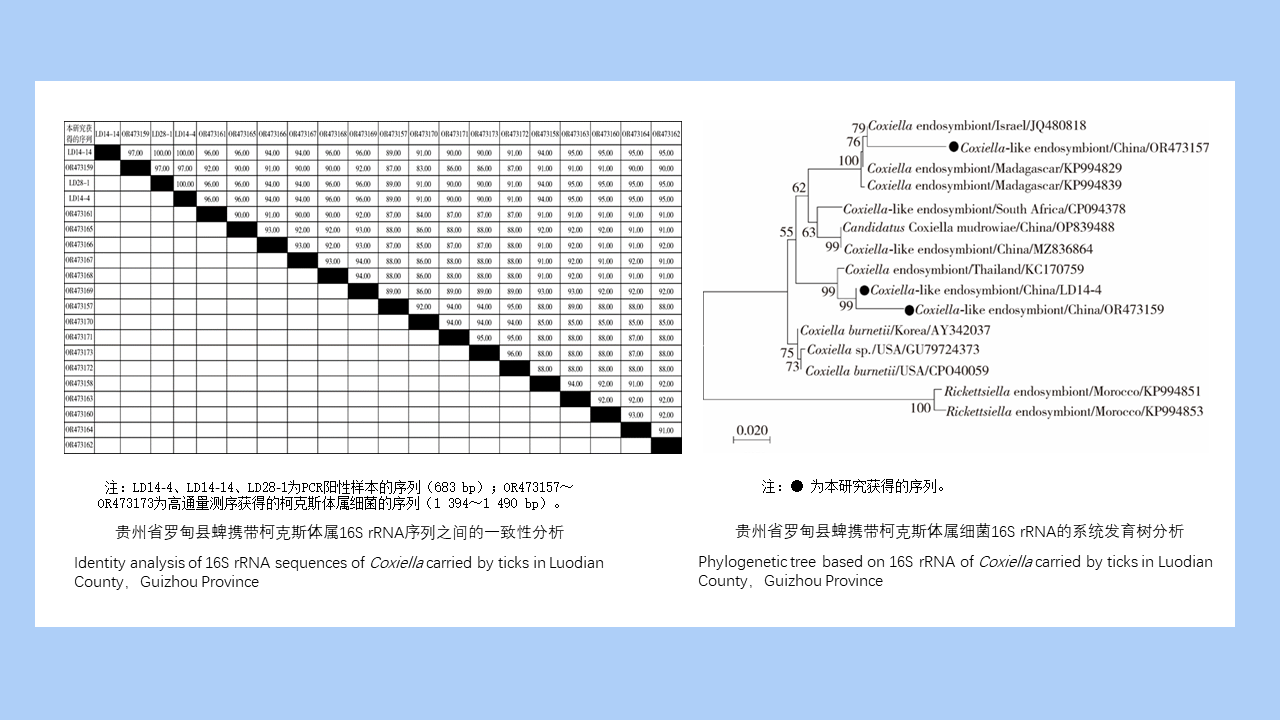
Objective To investigate the basic characteristics of bacteria in the genus Coxiella carried by parasitic ticks on the body surface of goats. Methods Ticks were collected from goats raised in free range in Luodian County, Guizhou Province, China. DNA was extracted from individual ticks and mixed for high-throughput sequencing of bacterial 16S rRNA amplicons. Moreover, individual tick DNA samples were also assayed by PCR with Coxiella-specific primers, which was combined with DNA sequencing to validate the results of high-throughput sequencing. Results A total of 66 ticks were collected in this study, including 63 Haemaphysalis longicornis and 3 Rhipicephalus microplus. A total of 17 reads of Coxiella-like endosymbiont were identified by 16S rRNA high-throughput sequencing. The prevalence rate was 28.78% (19/66) by PCR amplification of the 16S rRNA gene (683 bp) of Coxiella from individual ticks. The phylogenetic analysis based on 16S rRNA gene revealed that the Coxiella-like endosymbionts identified in this study were in the same branch with the Iseral strain (JQ480818) and the Thailand strain (KC170759). Conclusions These findings indicated that the prevalence of Coxiella-like endosymbionts was high in parasitic ticks on the body surface of goats raised in free range in Luodian County. The pathogenicity and the public health significance of the agent require further investigation in the future.
CHEN Qiu, HE Xian-hai, MENG Jiao, WU Sheng-chun, TANG Ji-xia, LIN Zhi-jun, YU Fu-xun, JIANG Jia-fu, SUN Yi, CAO Wu-chun, ZHAN Lin, ZHOU Yuan-zhong
. Analysis of genetic characteristics of Coxiella carried by parasitic ticks on goat body surface in Luodian County, Guizhou Province, China[J]. Chinese Journal of Vector Biology and Control, 2024
, 35(4)
: 417
-421
.
DOI: 10.11853/j.issn.1003.8280.2024.04.006
[1] Lu M, Tang GP, Ren ZQ,et al. Ehrlichia,Coxiella and Bartonella infections in rodents from Guizhou Province,southwest China[J]. Ticks Tick Borne Dis,2022,13(5):101974. DOI:10.1016/j.ttbdis.2022.101974.
[2] Xiong XL, Jiao J, Wen BH. Strengthen the prevention and control of Q fever in China[J]. Acta Parasitol Med Entomol Sin,2020,27(4):258-263. DOI:10.3969/j.issn.1005-0507.2020.04.011.(in Chinese)熊小路,焦俊,温博海. 加强我国Q热的防控[J]. 寄生虫与医学昆虫学报,2020,27(4):258-263. DOI:10.3969/j.issn.1005-0507.2020.04.011.
[3] Huang MX, Ma JM, Jiao J,et al. The epidemic of Q fever in 2018 to 2019 in Zhuhai City of China determined by metagenomic next-generation sequencing[J]. PLoS Negl Trop Dis,2021,15(7):e0009520. DOI:10.1371/journal.pntd.0009520.
[4] Lu ZY, Fu MJ, Xiong JF,et al. Investigation of rickettsiae in ticks from the northeast of Hubei Province[J]. Mil Med Sci,2021,45(4):262-266. DOI:10.7644/j.issn.1674-9960.2021.04.005.(in Chinese)卢志宇,付梦姣,熊进峰,等. 湖北省东北部地区蜱携立克次体的调查[J]. 军事医学,2021,45(4):262-266. DOI:10.7644/j.issn.1674-9960.2021.04.005.
[5] Chisu V, Mura L, Foxi C,et al. Coxiellaceae in ticks from Human,domestic and wild hosts from Sardinia,Italy:High diversity of Coxiella-like endosymbionts[J]. Acta Parasitol,2021,66(2):654-663. DOI:10.1007/s11686-020-00324-w.
[6] Shi MJ, Qin T, Liu ZT,et al. Molecular detection of Candidatus Coxiella mudorwiae in Haemaphysalis concinna in China[J]. Zoonoses,2022,2:39. DOI:10.15212/ZOONOSES-2022-0041.
[7] Sun L.Metagenomic bioinformatics analysis method[J]. Chin Qinghai J Anim Vet Sci, 2022, 52(1):64-67, 69. DOI:10.3969/j.issn.1003-7950.2022.01.016.(in Chinese)孙璐. 宏基因组生物信息学分析方法[J]. 青海畜牧兽医杂志,2022,52(1):64-67,69. DOI:10.3969/j.issn.1003-7950. 2022. 01.016.
[8] Yao JL, Chen ZG, Gong HY. Investigation of tick harbored bacteria and protoza from several animal species[J]. Chin J Vet Parasitol,2021,29(3):107-113. DOI:10.19958/j.cnki.cn31-2031/s.2021.03.016.(in Chinese)姚佳玲,陈兆国,龚海燕. 几种动物来源的蜱携带的细菌和原虫的检测[J]. 中国动物传染病学报,2021,29(3):107-113. DOI:10.19958/j.cnki.cn31-2031/s.2021.03.016.
[9] Xiang YL, Zhou JZ, Liu Y,et al. An investigation of ticks and tick-borne bacteria in some areas of Guizhou Province,China[J]. Chin J Vector Biol Control,2022,33(1):148-152. DOI:10. 11853/j.issn.1003.8280.2022.01.027.(in Chinese)向昱龙,周敬祝,刘英,等. 贵州省部分地区蜱及其携带细菌调查[J]. 中国媒介生物学及控制杂志,2022,33(1):148-152. DOI:10.11853/j.issn.1003.8280.2022.01.027.
[10] El-Mahallawy HS, Lu G, Kelly P,et al. Q fever in China:A systematic review,1989-2013[J]. Epidemiol Infect,2015,143(4):673-681. DOI:10.1017/S0950268814002593.
[11] Deng GF, Jiang ZJ. Economic insect fauna of China. Fasc. 39(Acari:Ixodidae) [M]. Beijing:Science Press,1991:34-43. (in Chinese)邓国藩,姜在阶. 中国经济昆虫志第三十九册蜱螨亚纲硬蜱科[M]. 北京:科学出版社,1991:34-43.
[12] Meng J, Chen XX, Zhang X,et al. Detection of Rickettsia raoultii in Rhipicephalus sanguineus parasitized on the body surfaces of dogs in pet centers in Wudang District,Guizhou,China[J]. Chin J Vector Biol Control,2022,33(4):536-542. DOI:10.11853/j.issn.1003.8280.2022.04.018.(in Chinese)孟娇,陈醒醒,张霞,等. 贵阳市乌当区宠物中心犬体表寄生血红扇头蜱检出劳氏立克次体[J]. 中国媒介生物学及控制杂志,2022,33(4):536-542. DOI:10.11853/j.issn. 1003. 8280. 2022.04.018.
[13] He PS. Genotyping of Coxiella burnetii carried by ticks and rats in some regions in China[D]. Hefei:Anhui Medical University,2023. DOI:10.26921/d.cnki.ganyu.2023.001710.(in Chinese)何培圣. 我国部分地区蜱和鼠类携带贝氏柯克斯体的基因分型研究[D]. 合肥:安徽医科大学,2023. DOI:10.26921/d.cnki.ganyu.2023.001710.
[14] Zhang PP, Wang YX, Sun XX. Etiological and epidemiological characteristics of Q fever and its prevention and control[J]. China Anim Health Insp,2021,38(1):81-86. DOI:10.3969/j.issn.1005-944X.2021.01.017.(in Chinese)张培培,王毓秀,孙翔翔. Q热病原学和流行病学特点及其防控[J]. 中国动物检疫,2021,38(1):81-86. DOI:10.3969/j.issn.1005-944X.2021.01.017.
[15] Li J, Wu CL, Tao F,et al. Serological investigation and analysis of three zoonoses in cattle and sheep in some areas of Guangxi[J]. Heilongjiang Anim Sci Vet Med,2020(4):66-70. DOI:10.13881/j.cnki.hljxmsy.2019.03.0232.(in Chinese)李军,吴翠兰,陶飞,等. 广西部分地区牛羊三种人兽共患病的血清学调查与分析[J]. 黑龙江畜牧兽医,2020(4):66-70. DOI:10.13881/j.cnki.hljxmsy.2019.03.0232.
[16] Duron O, Noël V, McCoy KD,et al. The recent evolution of a maternally-inherited endosymbiont of ticks led to the emergence of the Q fever pathogen,Coxiella burnetii[J]. PLoS Pathog,2015,11(5):e1004892. DOI:10.1371/journal.ppat.1004892.
[17] Thanchomnang T, Rodpai R, Thinnabut K,et al. Characterization of the bacterial microbiota of cattle ticks in northeastern Thailand through 16S rRNA amplicon sequencing[J]. Infect,Genet Evol,2023,115:105511. DOI:10.1016/j.meegid.2023.105511.
[18] Tian JH, Hou X, Ge MH,et al. The diversity and evolutionary relationships of ticks and tick-borne bacteria collected in China[J]. Parasit Vectors,2022,15(1):352. DOI:10.1186/s13071-022-05485-3.
[19] Li LH. Transmission of Babesia microti by ticks in Tengchong[D]. Beijing:Chinese Center for Disease Control and Prevention,2016. (in Chinese)李兰花. 腾冲市蜱媒传播田鼠巴贝虫研究[D]. 北京:中国疾病预防控制中心,2016.

