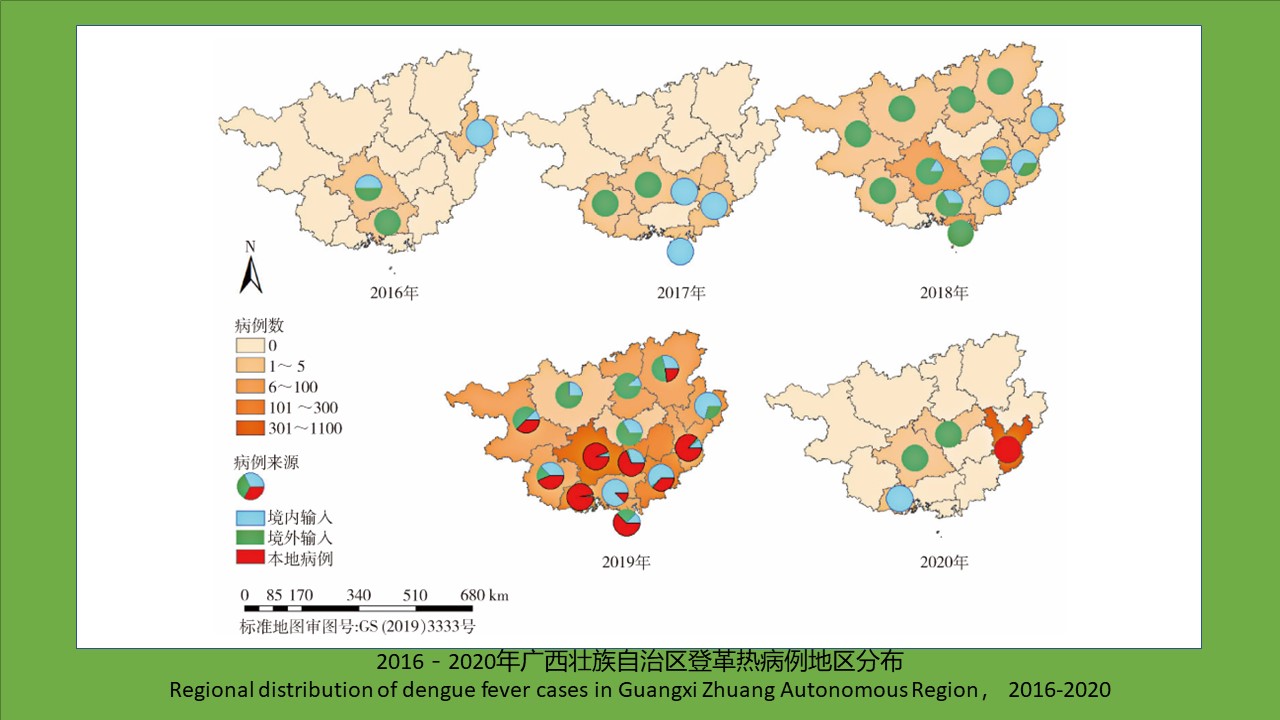
Objective To investigate the epidemiological characteristics of person, time, and place of dengue fever and their domestic and abroad sources in Guangxi Zhuang Autonomous Region (Guangxi), China from 2016 to 2020, and to provide a scientific basis for the prevention and control of dengue fever in the future. Methods The data on dengue fever in Guangxi from 2016 to 2020 were collected from the notifiable disease reporting system. With Excel 2010 and SPSS 20.0, descriptive epidemiological methods were used to analyze the epidemiological characteristics of imported and local cases of dengue fever in Guangxi in the past five years, and to analyze the source of infection and the epidemic pattern of dengue fever in Guangxi. Results A total of 2 183 dengue cases were reported in Guangxi from 2016 to 2020, with an average incidence of 0.89/100 000. Dengue fever was sporadic during 2016 to 2018, and occurred in outbreaks in 2019 and 2020. The incidence of dengue fever peaked in 2019, accounting for 80.20% of the total reported cases. The male-to-female ratio of imported cases was statistically higher than that of local cases (χ2=5.262, P=0.022).The majority of local cases were between 30 and 39 years old (22.61%) and the majority of imported cases were between 30 and 39 years old (27.94%). The local and imported cases showed similar trends in epidemic seasons, mainly in summer and autumn. The imported cases were mainly from Guangdong province in China (74 cases, 88.10%) and from Cambodia (83 cases, 65.35%). In terms of occupational distribution, domestic and overseas imported cases were mainly household workers and unemployed workers, accounting for 20.78% and 20.47% respectively, while domestic imported cases were mainly farmers (43.03%). Conclusion Dengue fever in Guangxi has an increased trend from sporadic patterns to outbreaks. It is important to strengthen the education on dengue control for key populations during epidemic seasons, to enhance the sensitivity of quarantine at entry and exit ports and the level of diagnosis in medical institutions, and to promptly identify and report cases, which are important for reducing the occurrence and spread of dengue fever.
Jing WANG, Fei LUO, Wei-tao HE, Li-na JIANG, Chao ZHANG, Mei LIN, Jun ZENG
. Epidemiological characteristics of dengue fever in Guangxi Zhuang Autonomous Region, China, 2016-2020[J]. Chinese Journal of Vector Biology and Control, 2023
, 34(1)
: 65
-69
.
DOI: 10.11853/j.issn.1003.8280.2023.01.012
[1] 龚甫哲, 龚震宇. 2018年9月世界卫生组织关于登革热疫苗的意见书[J]. 疾病监测, 2019, 34(3):278-284. Gong FZ, Gong ZY. Dengue vaccine:WHO position paper-September 2018[J]. Dis Surveill, 2019, 34(3):278-284. (in Chinese)
[2] World Health Organization. Global strategy for dengue prevention and control, 2012-2020[Z]. Geneva:World Health Organization, 2012.
[3] 张思华. 淮北市首起输入性登革热疫情的调查报告[J]. 安徽预防医学杂志, 2018, 24(4):291-292. Zhang SH. Investigation of the first imported dengue fever case in Huaibei city[J]. Anhui J Prev Med, 2018, 24(4):291-292. (in Chinese)
[4] 李东英, 孙玉红, 王新波, 等. 登革热疫情流行病学特征分析和防控措施[J]. 中国城乡企业卫生, 2018, 33(3):42-45. DOI:10.16286/j.1003-5052.2018.03.016. Li DY, Sun YH, Wang XB, et al. Epidemiological characteristics analysis and prevention and control measures of dengue fever[J]. Chin J Urban Rural Enterpr Hyg, 2018, 33(3):42-45. DOI:10.16286/j.1003-5052.2018.03.016.(in Chinese)
[5] 刘起勇. 我国登革热流行新趋势、防控挑战及策略分析[J]. 中国媒介生物学及控制杂志, 2020, 31(1):1-6. DOI:10.11853/j.issn.1003.8280.2020.01.001. Liu QY. Dengue fever in China:New epidemical trend, challenges and strategies for prevention and control[J]. Chin J Vector Biol Control, 2020, 31(1):1-6. DOI:10.11853/j.issn.1003.8280.2020.01.001.(in Chinese)
[6] Li JD, Xiong Y, Wu W, et al. Zika virus in a traveler returning to China from Caracas, Venezuela, February 2016[J]. Emerg Infect Dis, 2016, 22(6):1133-1136. DOI:10.1371/journal.ppat. 1000850.
[7] Kumaran E, Doum D, Keo V, et al. Dengue knowledge, attitudes and practices and their impact on community-based vector control in rural Cambodia[J]. PLoS Negl Trop Dis, 2018, 12(2):e0006268. DOI:10.1371/journal.pntd.0006268.
[8] World Health Organization. Dengue and severe dengue[EB/OL]. (2020-12-13)[2022-03-25]. https://www.who.int/health-topics/dengue-and-severe-dengue#tab=tab_1.
[9] 中国疾病预防控制中心. 登革热防治技术指南[Z]. 北京:中国疾病预防控制中心, 2014. Chinese Center for Disease Control and Prevention. Beijing:Chinese Center for Disease Control and Prevention, 2014. (in Chinese)
[10] 牟笛, 崔金朝, 殷文武, 等. 2015-2018年我国登革热暴发流行病学特征分析[J]. 中华流行病学杂志, 2020, 41(5):685-689. DOI:10.3760/cma.j.cn112338-20190715-00523. Mu D, Cui JC, Yin WW, et al. Epidemiological characteristics of dengue fever outbreaks in China, 2015-2018[J]. Chin J Epidemiol, 2020, 41(5):685-689. DOI:10.3760/cma.j.cn112338-20190715-00523.(in Chinese)
[11] 牟笛, 何泱霓, 陈秋兰, 等. 我国2016年登革热输入和本地病例流行病学特征比较[J]. 疾病监测, 2017, 32(3):184-189. DOI:10.3784/j.issn.1003-9961.2017.03.004. Mu D, He YN, Chen QL, et al. Comparison of epidemiological features between imported and indigenous dengue cases in China[J]. Dis Surveill, 2017, 32(3):184-189. DOI:10.3784/j.issn.1003-9961.2017.03.004.(in Chinese)
[12] 曾小平, 陈琴, 林春燕. 海口市2010-2020年输入性登革热流行病学特征[J]. 中国热带医学, 2021, 21(9):828-832. DOI:10.13604/j.cnki.46-1064/r.2021.09.03. Zeng XP, Chen Q, Lin CY. Epidemiological characteristics of imported dengue fever in Haikou, 2010-2020[J]. China Trop Med, 2021, 21(9):828-832. DOI:10.13604/j.cnki.46-1064/r.2021.09.03.(in Chinese)
[13] 刘昶权, 张国明, 韦广莹, 等. 2019年广东省480例登革热住院患者的流行病学和临床特征分析[J]. 中华传染病杂志, 2021, 39(4):209-213. DOI:10.3760/cma.j.cn311365-20200220-00093. Liu CQ, Zhang GM, Wei GY, et al. Analysis of epidemiological characteristics and clinical features of 480 hospitalized patients with dengue fever in Guangdong province in 2019[J]. Chin J Infect Dis, 2021, 39(4):209-213. DOI:10.3760/cma.j.cn311365-20200220-00093.(in Chinese)
[14] Cuong HQ, Vu NT, Cazelles B, et al. Spatiotemporal dynamics of dengue epidemics, southern Vietnam[J]. Emerg Infect Dis, 2013, 19(6):945-953. DOI:10.3201/eid1906.121323.
[15] 张萌, 何剑峰. 登革热流行趋势研究进展[J]. 新发传染病电子杂志, 2018, 3(2):72-74. DOI:10.19871/j.cnki.xfcrbzz.2018. 02.003. Zhang M, He JF. Dengue fever epidemic trend research progress[J]. Electr J Emerg Infect Dis, 2018, 3(2):72-74. DOI:10.19871/j.carolcarrollnkiXFCRBZZ.2018.02.003.(in Chinese)
[16] 黄秋婵, 区映研. 128例登革热患者流行病学及病原学监测结果分析[J]. 中国医学前沿杂志(电子版), 2018, 10(1):112-115. DOI:10.12037/YXQY.2018.01-25. Huang QC, Ou YY. Epidemiological and etiological analysis of 128 cases of dengue fever[J]. Chin J Front Med Sci (Electron Vers), 2018, 10(1):112-115. DOI:10.12037/YXQY.2018.01-25.(in Chinese)
[17] 李烨, 贺爱辉. 199例登革热患者临床特征分析[J]. 国际医药卫生导报, 2019, 25(8):1242-1244. DOI:10.3760/cma.j.issn.1007-1245.2019.08.018. Li Y, He AH. Analysis of clinical features of 199 cases of dengue fever[J]. Int Med Health Guid News, 2019, 25(8):1242-1244. DOI:10.3760/cma.j.issn.1007-1245.2019.08.018.(in Chinese)

