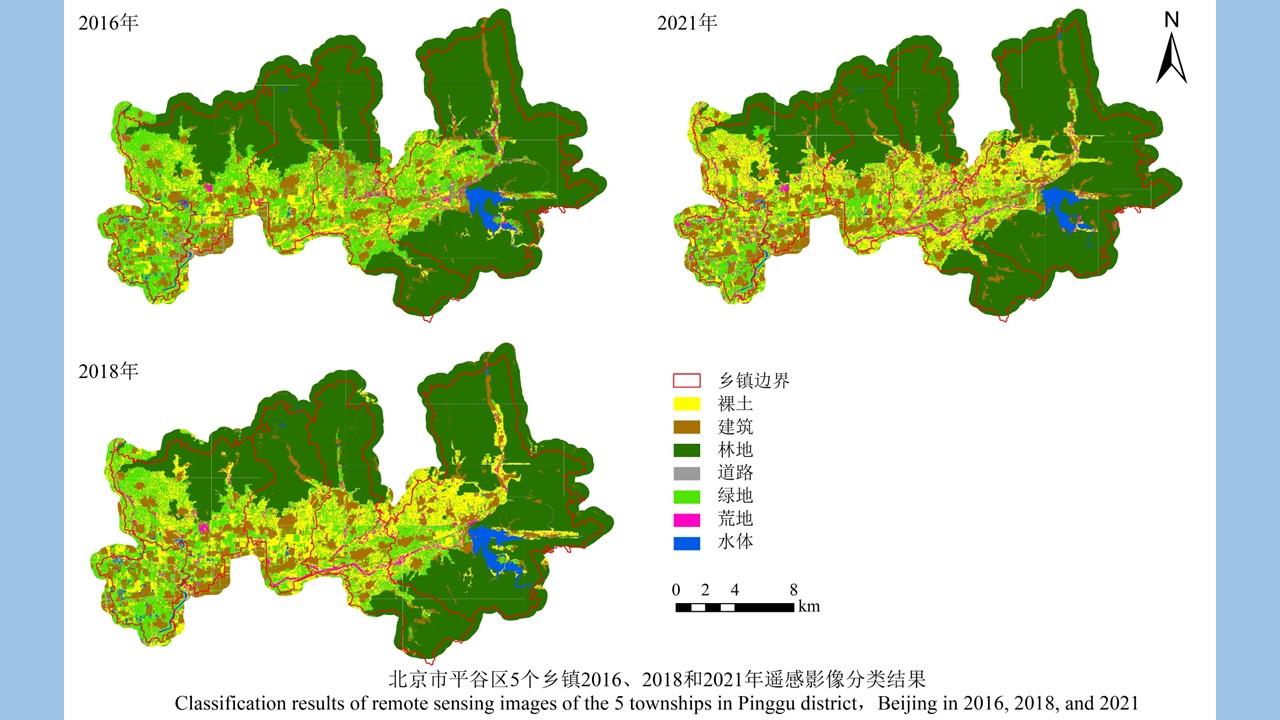
Objective To explore the relationship between the incidence of scrub typhus and land use in Pinggu district, Beijing, China. Methods The multi-scale segmentation and random forest algorithm in eCognition v9.0.1 software were performed to extract and classify the remote sensing image data of five townships (Wangxinzhuang town, Daxingzhuang town, Jinhaihu town, Nandulehe town, and Shandongzhuang town) in Pinggu district in 2016, 2018, and 2021 that had relatively large numbers of cases of scrub typhus. ArcGIS 10.7 software was used to calculate the area of each type of land in each township in each year. The relationship between the area of objects and the incidence of scrub typhus was analyzed through line graphs and Spearman's rank correlation analysis. Results The overall classification accuracy of remote sensing images of 5 towns in Pinggu district of Beijing in 3 years were all >80%, and the Kappa coefficients were between 0.600 and 0.800. The Spearman's rank correlation analysis showed that in the five townships, the incidence of scrub typhus was positively correlated with the ratio of green space area to non-forest land area from 2016 to 2018 (r=0.576, P=0.082), while there was no correlation between the incidence of scrub typhus and the proportion of object area from 2018 to 2021. From the perspectives of townships, in Nandulehe and Shandongzhuang towns, the incidence of scrub typhus was negatively correlated with bare soil/non-forest land ratio (all r=-1.000, all P<0.010), positively correlated with green space/non-forest land ratio (r=1.000, P<0.010), and negatively correlated with wasteland/non-forest land ratio (r=-1.000, P<0.010). However, there was a positive correlation between the incidence of scrub typhus and wasteland/non-forest land ratio in Jinhaihu town (r=1.000, P<0.010). The incidence of scrub typhus in the five townships was negatively correlated with building/non-forest land ratio in 2016 (r=-0.900, P=0.037), negatively correlated with water/non-forest land ratio in 2018 (r=-0.900, P=0.037), and positively correlated with water/non-forest land ratio in 2021 (r=0.900, P=0.037). Conclusion The incidence of scrub typhus in Pinggu district of Beijing was positively correlated with green space/non-forest land area ratio in 2016 and in 2018, but with no correlation between the two factors in 2018 and in 2021. The correlation results varied in different towns and different years.
ZHAO Jia-xin, LI Wen, LI Gui-chang, YUE Yu-juan, LIU Qi-yong, LU Liang
. Correlation between scrub typhus incidence and land use in Pinggu district, Beijing, China[J]. Chinese Journal of Vector Biology and Control, 2022
, 33(3)
: 371
-378
.
DOI: 10.11853/j.issn.1003.8280.2022.03.011
[1] 李贵昌, 栗冬梅, 李焱, 等. 2006-2016年我国恙虫病流行特征分析[J]. 疾病监测, 2018, 33(2):139-143. DOI:10.3784/j.issn.1003-9961.2018.02.007. Li GC, Li DM, Li Y, et al. Epidemiology of scrub typhus in China, 2006-2016[J]. Dis Surveill, 2018, 33(2):139-143. DOI:10.3784/j.issn.1003-9961.2018.02.007.(in Chinese)
[2] 吴光华. 我国恙虫病的流行病学特点与防治策略[J]. 中国公共卫生, 2000, 16(9):777-779. DOI:10.3321/j.issn:1001-0580. 2000.09.003. Wu GH. Epidemiological characteristics and control strategies of scrub typhus in China[J]. China Public Health, 2000, 16(9):777-779. DOI:10.3321/j.issn:1001-0580.2000.09.003.(in Chinese)
[3] 吴家兵. 我国恙虫病疫源地研究进展[J]. 安徽预防医学杂志, 2010, 16(6):467-469. Wu JB. Progress of research on tsutsugamushi foci in China[J]. Anhui J Prev Med, 2010, 16(6):467-469. (in Chinese)
[4] 鲁志新, 胡玲美, 鲁齐, 等. 试论我国恙虫病自然疫源地类型[J]. 中国人兽共患病杂志, 1998, 14(6):63-66. Lu ZX, Hu LM, Lu Q, et al. Discussion on types of scrub typhus natural foci in China[J]. Chin J Zoonoses, 1998, 14(6):63-66. (in Chinese)
[5] 北京市平谷区人民政府. 平谷概况[EB/OL]. (2021-06-11)[2022-02-20]. http://www.bjpg.gov.cn/pgqrmzf/zjpg/pggk16/266169/index.html. Beijing Pinggu District People's Government. Pinggu overview[EB/OL]. (2021-06-11)[2022-02-20]. http://www.bjpg.gov.cn/pgqrmzf/zjpg/pggk16/266169/index.html.(in Chinese)
[6] 王玉姣, 闫冬明, 李贵昌, 等. 北京市平谷区2008-2018年恙虫病流行特征分析[J]. 中国媒介生物学及控制杂志, 2019, 30(3):244-247. DOI:10.11853/j.issn.1003.8280.2019.03.003. Wang YJ, Yan DM, Li GC, et al. Epidemiological characteristics of scrub typhus in Pinggu district of Beijing, China, in 2008-2018[J]. Chin J Vector Biol Control, 2019, 30(3):244-247. DOI:10.11853/j.issn.1003.8280.2019.03.003.(in Chinese)
[7] 李贵昌, 王玉姣, 母群征, 等. 北京市平谷区恙虫病自然疫源地宿主、媒介和病原体调查[J]. 中国媒介生物学及控制杂志, 2021, 32(3):291-297. DOI:10.11853/j.issn.1003.8280.2021. 03.007. Li GC, Wang YJ, Mu QZ, et al. An investigation of the hosts, vectors, and pathogens of scrub typhus in Pinggu natural focus of Beijing, China[J]. Chin J Vector Biol Control, 2021, 32(3):291-297. DOI:10.11853/j.issn.1003.8280.2021.03.007.(in Chinese)
[8] Lerdthusnee K, Nigro J, Monkanna T, et al. Surveys of rodent-borne disease in Thailand with a focus on scrub typhus assessment[J]. Integr Zool, 2008, 3(4):267-273. DOI:10.1111/j.1749-4877.2008.00100.x.
[9] Wardrop NA, Kuo CC, Wang HC, et al. Bayesian spatial modelling and the significance of agricultural land use to scrub typhus infection in Taiwan[J]. Geospat Health, 2013, 8(1):229-239. DOI:10.4081/gh.2013.69.
[10] 吴义城. 我国大陆地区恙虫病时空特征分析及风险预测研究[D]. 北京:中国人民解放军军事医学科学院, 2016. Wu YC. Study on spatiotemporal dynamics and risk prediction of scrub typhus in China's mainland[D]. Beijing:Academy of Military Medical Sciences, 2016. (in Chinese)
[11] 孙烨. 我国恙虫病地方性流行南北异质性比较研究[D]. 北京:中国人民解放军军事医学科学院, 2016. Sun Y. A comparative study on the epidemiological heterogeneity of scrub typhus between northern and southern China[D]. Beijing:Academy of Military Medical Sciences, 2016. (in Chinese)
[12] 李文. 基于多模型的中国恙虫病高风险区流行风险因素分析[D]. 北京:中国疾病预防控制中心, 2021. Li W. Analysis of epidemic risk factors in high-risk areas of scrub typhus in China based on multi-model[D]. Beijing:Chinese Center for Disease Control and Prevention, 2021. (in Chinese)
[13] 王增亮, 高杰, 陶波, 等. 应用高分辨率中巴资源卫星遥感图像探测湖沼地区钉螺孳生地的初步研究[J]. 中国血吸虫病防治杂志, 2012, 24(6):640-644. DOI:10.3969/j.issn.1005-6661. 2012.06.006. Wang ZL, Gao J, Tao B, et al. Preliminary study on applying high-resolution CBERS images to identify Oncomelania snail habitats in lake and marshland regions[J]. Chin J Schisto Control, 2012, 24(6):640-644. DOI:10.3969/j.issn.1005-6661.2012.06.006.(in Chinese)
[14] 常变蓉, 李仁东, 徐兴建, 等. 江汉平原土地利用对钉螺分布的影响研究[J]. 长江流域资源与环境, 2014, 23(3):380-384. DOI:10.11870/cjlyzyyhj201403011. Chang BR, Li RD, Xu XJ, et al. Impact of land use on Oncomelania's distribution in Jianghan plain[J]. Resour Environ Yangtze Basin, 2014, 23(3):380-384. DOI:10.11870/cjlyzyyhj201403011.(in Chinese)
[15] Jin HS, Chu C, Han DY. Spatial distribution analysis of scrub typhus in Korea[J]. Osong Public Health Res Perspect, 2013, 4(1):4-15. DOI:10.1016/j.phrp.2012.12.007.
[16] Zheng CJ, Jiang D, Ding FY, et al. Spatiotemporal patterns and risk factors for scrub typhus from 2007 to 2017 in southern China[J]. Clin Infect Dis, 2019, 69(7):1205-1211. DOI:10.1093/cid/ciy1050.
[17] Kuo CC, Huang JL, Ko CY, et al. Spatial analysis of scrub typhus infection and its association with environmental and socioeconomic factors in Taiwan[J]. Acta Trop, 2011, 120(1/2):52-58. DOI:10.1016/j.actatropica.2011.05.018.

