调查研究

天津市津南区2021、2024年德国小蠊对6种杀虫剂的抗药性调查

  • 王兵圣
展开
  • 天津市津南区疾病预防控制中心综合监测科, 天津 300350

王兵圣,男,主管医师,主要从事病媒生物防治工作,E-mail:

收稿日期: 2024-12-31

  网络出版日期: 2025-08-26

版权

版权所有,未经授权,不得转载。

Resistance of Blattella germanica to six insecticides in Jinnan District of Tianjin in 2021 and 2024

  • Bing-sheng WANG
Expand
  • Comprehensive Monitoring Department, Jinnan Center for Disease Control and Prevention of Tianjin, Jinnan, Tianjin 300350, China

Received date: 2024-12-31

  Online published: 2025-08-26

Copyright

All rights reserved. Unauthorized reproduction is prohibited.

摘要

目的: 了解2021与2024年天津市津南区德国小蠊对常用杀虫剂的抗药性水平及变化,为津南区卫生杀虫剂使用提供技术指导。方法: 在津南区不同方位采集德国小蠊,选取饲养繁殖的F1代雄性成虫作为实验试虫。按照《蜚蠊抗药性检测方法: 德国小蠊生物测定法》(GB/T26352-2010)中的诊断剂量法—药膜法测定德国小蠊对6种常用杀虫剂的抗药性,采用SSPS 19.0软件计算毒力回归线法得出半数击倒时间(KT50)及95%置信区间(CI),同时根据参考文献中的敏感品系KT50计算抗性倍数。结果: 2021年德国小蠊对6种杀虫剂的抗性倍数由低到高依次为:残杀威0.52(敏感)、高效氯氟氰菊酯2.34(低抗)、乙酰甲胺磷2.54(低抗)、高效氯氰菊酯3.53(低抗)、氯菊酯4.60(低抗)、溴氰菊酯5.03(低抗);2024年抗性倍数由低到高依次为:乙酰甲胺磷1.51(敏感)、残杀威2.78(低抗)、高效氯氟氰菊酯7.77(低抗)、高效氯氰菊酯9.03(低抗)、溴氰菊酯11.26(中抗)、氯菊酯32.80(高抗)。2024年津南区德国小蠊抗性水平与2021年相比,氯菊酯由低抗升至高抗,溴氰菊酯由低抗升至中抗,高效氯氰菊酯、高效氯氟氰菊酯处于低抗,但抗性倍数升高,残杀威由敏感升至低抗。结论: 2024年津南区德国小蠊对6种杀虫剂抗性水平较2021年升高,对拟除虫菊酯类杀虫剂的抗性水平上升明显,建议将氯菊酯、溴氰菊酯类杀虫剂暂时停用,采取轮换用药或新型灭蟑药物等方式,以延缓津南区德国小蠊对常用杀虫剂的抗性水平升高趋势。

本文引用格式

王兵圣 . 天津市津南区2021、2024年德国小蠊对6种杀虫剂的抗药性调查[J]. 中国媒介生物学及控制杂志, 2025 , 36(4) : 552 -555 . DOI: 10.11853/j.issn.1003.8280.2025.04.020

Abstract

Objective: To investigate the changes in the resistance of Blattella germanica to commonly used insecticides in Jinnan District, Tianjin, China in 2021 and 2024, so as to provide technical guidance for the use of sanitary insecticides against B. germanica in Jinnan District. Methods: B. germanica were collected from different directions in Jinnan District, and the F1 generation male adults were selected as the experimental insects. They were tested for the levels of resistance to six commonly used insecticides according to the residual film method of diagnostic dose method recommended by the Test Methods of Cockroach Resistance to InsecticidesThe Bioassay Methods for B. germanica (GB/T26352-2010). The median knockdown time (KT50) and 95% confidence interval were calculated using the toxicity regression line method in SPSS 19.0. The resistance ratio (RR) was calculated based on the KT50 of sensitive strains in relevant literature. Results: In 2021, RR of B. germanica to six insecticides ranged from low to high: propoxur (RR=0.52, susceptible), lambda-cyhalothrin (RR=2.34, low resistance), acephate (RR=2.54, low resistance), beta-cypermethrin (RR=3.53, low resistance), permethrin (RR=4.60, low resistance), and deltamethrin (RR=5.03, low resistance). RR in 2024 ranged from low to high: acephate (RR=1.51, susceptible), propoxur (RR=2.78, low resistance), lambda-cyhalothrin (RR=7.77, low resistance), beta-cypermethrin (RR=9.03, low resistance), deltamethrin (RR=11.26, medium resistance), and permethrin (RR=32.80, high resistance). From 2021 to 2024 in Jinnan District, the resistance of B. germanica to permethrin increased from low to high levels; the resistance to deltamethrin increased from low to medium levels; the resistance to beta-cypermethrin and lambda-cyhalothrin persisted at low level, but an increasing trend in RR had been observed; and the response to propoxur changed from suscepitible status to low resistance. Conclusions: The resistance levels of B. germanica to six insecticides in Jinnan District increase in 2024 compared with 2021, with notable increases in resistance to pyrethroids. It is suggested to suspend using permethrin and deltamethrin and adopting insecticide rotation strategies or new cockroach control methods, so as to delay the progression in the resistance of B. germanica to common insecticides in Jinnan District.

蜚蠊适应、繁殖能力强,且易携带多种病原体危害人类健康[1],在我国大部分地区均有分布[2-4],化学防治具有见效快、适用范围广、方便等特点,一直作为德国小蠊(Blattella germanica)的主要防治手段被广泛使用。暴露于杀虫剂的德国小蠊种群中的一些个体幸存下来,经过多代繁殖,种群中的大量个体可能对每一代新的杀虫剂或相同类别杀虫剂产生抗药性[5]。在我国各地均有德国小蠊对有机磷类、氨基甲酸酯类和拟除虫菊酯类杀虫剂产生抗药性的报道,且因区域用药的不同导致差异性较大[2-4]。2019年天津市津南区卫生城市创建工作逐步开展,卫生杀虫剂被广泛用于病媒生物防治,本研究调查津南区德国小蠊对3类6种常用杀虫剂的抗药性状况,为当地科学合理使用卫生杀虫剂提供依据。

1 材料与方法

1.1 试虫

2021与2024年均在津南区东、南、西、北、中5个方位,选取葛沽镇、八里台镇、双港镇、双桥河镇、咸水沽镇的居民区、餐饮、农贸市场、食品加工销售场所等蜚蠊密度较高且人群活动频繁的区域采集试虫,以奶粉、白糖、水正常饲养,试验条件:温度(25±1)℃,相对湿度50%~80%,选取F1代羽化后7~15日龄,体态正常,无残疾,活动敏捷的雄性成虫作为试虫。

1.2 药剂

3大类6种药剂包括:拟除虫菊酯类(98.0%溴氰菊酯、94.5%高效氯氰菊酯、90.00%氯菊酯、97.80%高效氯氟氰菊酯)、有机磷类(96.4%乙酰甲胺磷)、氨基甲酸酯类(97.00%残杀威),均由中国疾病预防控制中心传染病预防控制所统一提供标定的药剂原药(油)。

1.3 方法

采用《蜚蠊抗药性检测方法 德国小蠊生物测定法》(GB/T 26352-2010)中的诊断剂量法—药膜法。按照《天津市重要病媒生物(德国小蠊)抗药性监测方案》,将6种药剂用丙酮配置成0.05%丙酮溶液。每次分别加2.5 ml上述不同药液于500 ml玻璃锥形瓶中,不断转动锥形瓶使药液均匀分布于瓶内壁,置于通风橱中过夜,在瓶口内颈涂抹石蜡油和凡士林的等比例混合物,供给水和食物,用纱网或纱布封口,以防蜚蠊逃逸。每瓶放入试虫10只,观察记录不同时间试虫击倒数,直至133 min,每种药剂处理重复3次,计算半数击倒时间(KT50)及其95%置信区间(confidence interval,CI),同时记录24 h死亡数,计算死亡率。以丙酮处理为对照组,对照亦重复3次。试虫死亡判定标准:用锐器触动,不能正常爬行或者完全不动视为死亡。

1.4 数据处理

采用SSPS 19.0软件进行数据统计,以毒力回归线法计算KT50及其95%CI和抗性倍数(resistance ratio,RR)。RR=津南区KT50/敏感品系KT50。根据文献判定抗性标准[6],RR≥20定义为高抗性水平(高抗),10≤RR < 20为中等抗性水平(中抗),2≤RR < 10为低抗性水平(低抗),RR < 2为敏感。

2 结果

2.1 6种杀虫剂对德国小蠊24 h致死情况

2021年津南区德国小蠊对6种杀虫剂24 h死亡率均为100%;2024年津南区溴氰菊酯、高效氯氰菊酯、氯菊酯对德国小蠊的24 h死亡率分别为93.33%、96.67%和63.33%,高效氯氟氰菊酯、乙酰甲胺磷、残杀威的24 h死亡率均为100%。见表 1
表1 2024年与2021年天津市津南区德国小蠊对6种杀虫剂抗药性结果对比

Tab. 1 Comparison of the resistance of Blattella germanica to six insecticides in Jinnan District, Tianjin in 2021 and 2024

药剂名称 年份 试虫数(只) 24 h死亡率(%) 毒力回归方程(y=a+bx KT50及95%CI(min) 敏感品系KT50(min) 抗性倍数 抗性级别
溴氰菊酯 2024 30 93.33 y=-2.70+2.25x 44.04(30.54~63.51) 3.91 11.26 中抗
2021 30 100.00 y=-6.93+2.33x 19.69(18.29~21.13) 5.03 低抗
高效氯氰菊酯 2024 30 96.67 y=-3.95+2.67x 37.13(27.27~50.54) 4.11 9.03 低抗
2021 30 100.00 y=-6.28+2.35x 14.51(13.48~15.61) 3.53 低抗
氯菊酯 2024 30 63.33 y=-4.35+2.36x 151.35(106.79~214.52) 4.62 32.80 高抗
2021 30 100.00 y=-5.33+1.74x 21.26(19.30~23.43) 4.60 低抗
高效氯氟氰菊酯 2024 30 100.00 y=-12.51+5.18x 40.07(34.18~46.98) 5.16 7.77 低抗
2021 30 100.00 y=-3.47+1.39x 12.05(10.45~13.88) 2.34 低抗
乙酰甲胺磷 2024 30 100.00 y=-11.89+4.74x 61.15(51.39~72.77) 40.46 1.51 敏感
2021 30 100.00 y=-14.18+3.06x 102.72(97.05~108.27) 2.54 低抗
残杀威 2024 30 100.00 y=-9.29+4.36x 31.58(26.10~38.09) 11.36 2.78 低抗
2021 30 100.00 y=-1.66+0.93x 5.90(4.85~7.17) 0.52 敏感

注:溴氰菊酯、高效氯氰菊酯、氯菊酯、乙酰甲胺磷、残杀威敏感品系KT50参考文献[7],高效氯氟氰菊酯敏感品系KT50参考文献[8],对照组死亡率均 < 5%。

2.2 德国小蠊对6种杀虫剂的抗性倍数和级别

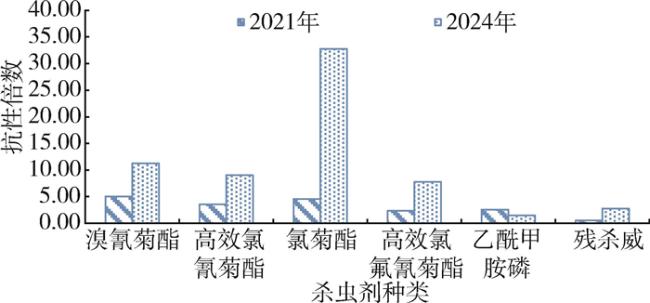
2021年津南区德国小蠊对6种杀虫剂的RR由低到高分别为:残杀威0.52(敏感)、高效氯氟氰菊酯2.34(低抗)、乙酰甲胺磷2.54(低抗)、高效氯氰菊酯3.53(低抗)、氯菊酯4.60(低抗)、溴氰菊酯5.03(低抗);2024年津南区德国小蠊对6种杀虫剂的RR由低到高分别为:乙酰甲胺磷1.51(敏感)、残杀威2.78(低抗)、高效氯氟氰菊酯7.77(低抗)、高效氯氰菊酯9.03(低抗)、溴氰菊酯11.26(中抗)、氯菊酯32.80(高抗),见表 1。2024年津南区德国小蠊抗性水平与2021年相比,氯菊酯由低抗升至高抗,溴氰菊酯由低抗升至中抗,高效氯氰菊酯、高效氯氟氰菊酯仍处于低抗,但RR升高,残杀威由敏感升至低抗,乙酰甲胺磷由低抗降至敏感,见图 1
图1 2021、2024年天津市津南区德国小蠊对6种杀虫剂抗性水平对比

Fig. 1 Comparison of the resistance of Blattella germanica to six insecticides in Jinnan District, Tianjin in 2021 and 2024

3 讨论

天津市津南区德国小蠊抗药性水平总体呈显著上升趋势,主要表现为对拟除虫菊酯类杀虫剂抗药性水平升高明显,特别是对氯菊酯,已达到高抗水平,24 h死亡率仅为63.33%,与2021年天津市河东区[9]报道的结果基本一致。王伟等[10]研究发现,2009-2010年津南区德国小蠊对高效氯氰菊酯、氯菊酯已呈现高抗,分析原因可能是当时拟除虫菊酯类杀虫剂在天津市范围内已被广泛应用,天津市2007-2009年相关统计显示,拟除虫菊酯类杀虫剂品种占当时市面销售杀虫剂品类数的比例达到69.2%[11]。相较2009-2010年,2021年津南区德国小蠊对高效氯氰菊酯、氯菊酯抗性水平均表现不同程度的下降,可能是由于随着津南区抗药性监测工作的逐步开展,病媒生物的抗药性问题越来越受到重视,针对相关杀虫剂的高抗、中抗现象,采取了针对性控制措施,使得部分杀虫剂的抗性出现下降趋势。但随着2019年津南区开始卫生城市创建工作,对于病媒生物的治理加强,特别是杀虫剂的使用量、使用频次增多,部分杀虫剂的抗性又出现了上升现象。
蜚蠊抗药性的产生,一般与某类杀虫剂的长期、大量使用有关,某一杀虫剂的长期、大量使用会造成部分抗性个体和种群生存下来,通过遗传繁殖,进而逐步演变成为对该类杀虫剂的耐药[12]。德国小蠊对杀虫剂的抗药性是一个动态的发展过程,与杀虫剂的使用量、频次和时间密切相关,抗药性水平也是可逆的,可以通过停用某类杀虫剂来降低其抗性水平。津南区德国小蠊对乙酰甲胺磷和残杀威处于敏感或低抗,这与浙江省2018年德国小蠊抗药性监测结果报道[13]基本一致,这可能与乙酰甲胺磷和残杀威在津南区德国小蠊的防治中用量较少有关。
德国小蠊防制应坚持综合防制原则,以环境整治为主、物理和化学治理为辅的总方针政策[14]。环境治理包括及时清理孳生地、做好环境卫生、管理食物、堵洞抹缝;物理灭蟑法有粘蟑纸、粘蟑盒等。针对津南区德国小蠊抗药性问题,建议将氯菊酯和溴氰菊酯类杀虫剂暂停使用,具体暂停时长可根据后续监测结果适时调整,可考虑选择高效氯氰菊酯、高效氯氟氰菊酯、乙酰甲胺磷、残杀威等低抗或敏感的药物,同时注意避免长时间单一用药,可以采取每年轮换用药的方式。建议在抗药性监测基础上,针对区政府部门、市场有害生物防治公司等主要使用的杀虫剂产品开展德国小蠊控制效果评估工作。另外,相关文献报道,生物灭蟑法和新型灭蟑饵剂等可以高效控制多种有害昆虫,对人和其他非靶向生物安全,具有高靶向性、环境污染小等优点[15-16],可以考虑在津南区德国小蠊防控工作中逐步应用。

利益冲突  无

1
刘俊, 林晨, 元永艇, 等. 上海市浦东新区餐饮场所蜚蠊侵害及携带肠道病原体分析[J]. 中国媒介生物学及控制杂志, 2023, 34 (4): 467- 471.

DOI

Liu J, Lin C, Yuan YT, et al. An analysis of cockroach infestation and its intestinal pathogens in catering places in Pudong New Area, Shanghai, China[J]. Chin J Vector Biol Control, 2023, 34 (4): 467- 471.

DOI

2
王纯玉, 白玉银, 张家勇, 等. 辽宁省2015-2020年蜚蠊监测结果分析[J]. 中国媒介生物学及控制杂志, 2022, 33 (2): 225- 229.

DOI

Wang CY, Bai YY, Zhang JY, et al. Analysis of surveillance results of cockroaches in Liaoning Province, China, 2015-2020[J]. Chin J Vector Biol Control, 2022, 33 (2): 225- 229.

DOI

3
梁倩, 刘文杰, 马伟, 等. 山东省2010-2020年餐饮行业蜚蠊监测结果分析[J]. 中国媒介生物学及控制杂志, 2023, 34 (5): 648- 653.

Liang Q, Liu WJ, Ma W, et al. An analysis of cockroach surveillance results in catering industry in Shandong Province, China, 2010-2020[J]. Chin J Vector Biol Control, 2023, 34 (5): 648- 653.

4
胡远峰, 谭梁飞. 湖北省鄂州市2016-2020年蜚蠊密度及抗药性监测结果分析[J]. 中国媒介生物学及控制杂志, 2021, 32 (5): 599- 603.

DOI

Hu YF, Tan LF. Surveillance results of cockroach density and insecticide resistance in Ezhou of Hubei Province, China, 2016-2020[J]. Chin J Vector Biol Control, 2021, 32 (5): 599- 603.

DOI

5
高希武, 梁沛. 昆虫毒理学[M]. 北京: 中国农业大学出版社, 2022: 160- 239.

Gao XW, Liang P. Insect toxicology[M]. Beijing: China Agricultural University Press, 2022: 160- 239.

6
樊坚, 金姝青, 陈茜茜, 等. 2022年上海市黄浦区蜚蠊密度及德国小蠊抗药性监测分析[J]. 中华卫生杀虫药械, 2024, 30 (1): 41- 44.

Fan J, Jin SQ, Chen XX, et al. Cockroach density and Blattella germanica insecticide resistance in Huangpu District of Shanghai in 2022[J]. Chin J Hyg Insect Equip, 2024, 30 (1): 41- 44.

7
侯银续, 苏宝, 芮振宇, 等. 2022年度宿州市德国小蠊对6种常用杀虫剂的抗药性调查[J]. 中华卫生杀虫药械, 2024, 30 (2): 109- 112.

DOI

Hou YX, Su B, Rui ZY, et al. Investigation on the resistance of Blattella germanica to 6 insecticides in Suzhou City in 2022[J]. Chin J Hyg Insect Equip, 2024, 30 (2): 109- 112.

DOI

8
侯银续, 王斐, 安洲, 等. 安徽省芜湖市2022年德国小蠊对常用卫生杀虫剂的抗药性调查[J]. 中国媒介生物学及控制杂志, 2023, 34 (5): 612- 616.

DOI

Hou YX, Wang F, An Z, et al. Resistance of Blattella germanica to commonly used insecticides in Wuhu, Anhui Province, China, 2022[J]. Chin J Vector Biol Control, 2023, 34 (5): 612- 616.

DOI

9
孙慧, 孙欣, 王金柱. 2021年天津市河东区家蝇和德国小蠊的抗药性调查[J]. 中华卫生杀虫药械, 2022, 28 (6): 493- 495.

DOI

Sun H, Sun X, Wang JZ. Insecticide resistance of Musca domestica and Blattella germanica in Hedong District of Tianjin in 2021[J]. Chin J Hyg Insect Equip, 2022, 28 (6): 493- 495.

DOI

10
王伟, 吴彤宇, 张咏梅, 等. 天津市德国小蠊对常用杀虫剂的抗药性测定[J]. 中国媒介生物学及控制杂志, 2011, 22 (6): 567- 569.

Wang W, Wu TY, Zhang YM, et al. Resistance of Blattella gemanica to commonly used pesticides in Tianjin[J]. Chin J Vector Biol Control, 2011, 22 (6): 567- 569.

11
吴彤宇, 张静, 秦娜, 等. 天津市卫生杀虫剂使用现状调查[J]. 中华卫生杀虫药械, 2013, 19 (1): 31- 32.

DOI

Wu TY, Zhang J, Qin N, et al. Investigation on the use of insecticides in Tianjin[J]. Chin J Hyg Insect Equip, 2013, 19 (1): 31- 32.

DOI

12
王金娜, 刘钦梅, 吴瑜燕, 等. 浙江省2017-2022年德国小蠊对5种杀虫剂抗药性监测结果分析[J]. 中国媒介生物学及控制杂志, 2024, 35 (5): 523- 528.

DOI

Wang JN, Liu QM, Wu YY, et al. Resistance of Blattella germanica to five insecticides in Zhejiang Province, China, 2017-2022[J]. Chin J Vector Biol Control, 2024, 35 (5): 523- 528.

DOI

13
李天奇, 吴瑜燕, 刘钦梅, 等. 浙江省2018年德国小蠊抗药性监测结果分析[J]. 中国媒介生物学及控制杂志, 2022, 33 (4): 462- 465.

DOI

Li TQ, Wu YY, Liu QM, et al. Surveillance results of the insecticide resistance of Blattella germanica in Zhejiang Province of China, 2018[J]. Chin J Vector Biol Control, 2022, 33 (4): 462- 465.

DOI

14
张艳, 宋丙栋, 孙燕群, 等. 南京市2012-2022年德国小蠊密度和侵害率与抗药性变化分析[J]. 中国媒介生物学及控制杂志, 2024, 35 (3): 308-311, 342.

DOI

Zhang Y, Song BD, Sun YQ, et al. Changes in the population density, infestation rate, and insecticide resistance of Blattella germanica in Nanjing, China, 2012-2022[J]. Chin J Vector Biol Control, 2024, 35 (3): 308-311, 342.

DOI

15
肖汉森, 何亚明, 季恒青. 灭蟑饵剂的研究及应用进展[J]. 中国媒介生物学及控制杂志, 2021, 32 (5): 642- 646.

DOI

Xiao HS, He YM, Ji HQ. Advances in research and application of cockroach-killing baits[J]. Chin J Vector Biol Control, 2021, 32 (5): 642- 646.

DOI

16
张晓, 王东, 辛正. 生物防治技术在卫生害虫防制中的研究和应用进展[J]. 中国媒介生物学及控制杂志, 2021, 32 (3): 378- 384.

DOI

Zhang X, Wang D, Xin Z. Research and application progress in biological control technology for hygiene pest control[J]. Chin J Vector Biol Control, 2021, 32 (3): 378- 384.

DOI

文章导航

/