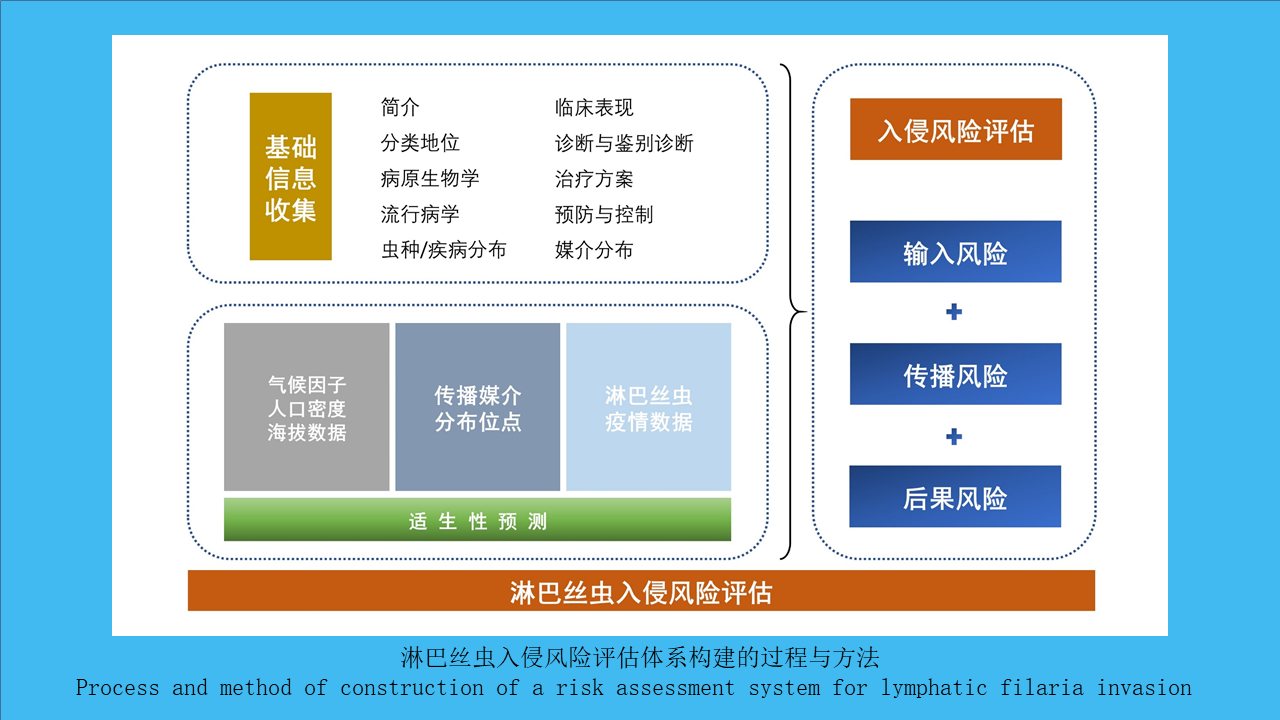
Objective To establish a risk assessment system for lymphatic filaria invasion in China, and to offer scientific evidence for the risk assessment and prevention and control of lymphatic filaria invasion in China. Methods Based on data on climate factors, population density, altitude, and the distribution of filarial vector mosquitoes downloaded from the Global Biodiversity Information Facility, a MaxEnt model was used to project the potential distribution of vector mosquitoes in China under different future climate scenarios. Through literature review and expert consultation, assessment indicators and assignment criteria were determined to construct a risk assessment system for evaluating the risk level of lymphatic filaria invasion in China. Results Through literature review and two rounds of expert consultation, three primary indicators and 16 secondary indicators were included in the lymphatic filaria invasion risk assessment system. There were six indicators for import risk (scored 0-4), six indicators for transmission risk (scored 0-4), and four indicators for consequence risk (scored 0-2). A pooled risk score of 0-3 was defined as low risk, 4-6 as medium risk, 7-8 as high risk, and 9-10 as extremely high risk. The Kendall’s coefficients of concordance for the first and second rounds of expert consultation were 0.713 and 0.825, respectively, indicating a good level of agreement. According to suitable habitat prediction, its vectors Anopheles sinensis, Culex pipiens quinquefasciatus, and An. barbirostris had broad distributions with increasing trends in China. The risk levels of Wuchereria bancrofti, Brugia malayi, and B. timori invasions in China were medium, medium, and low, respectively. Conclusions A lymphatic filaria invasion risk assessment system is established for the first time, which provides a basis for post-elimination risk assessment of lymphatic filaria invasion and control of key risk factors.
[1] 吴观陵. 人体寄生虫学[M]. 4版. 北京:人民卫生出版社, 2013:654-690.Wu GL. Human parasitology[M]. 4th ed. Beijing:People's Medical Publishing House, 2013:654-690. (in Chinese)
[2] World Health Organization. Global programme to eliminate lymphatic filariasis:Annual report on lymphatic filariasis 2001[M]. Geneva:WHO, 2002:5-8.
[3] 白剑峰. 我国率先在全球消除丝虫病[J]. 临床荟萃, 2009, 24(4):289.Bai JF. China took the lead in the global elimination of filariasis[J]. Clin Focus, 2009, 24(4):289. (in Chinese)
[4] 孙德建. 我国消除淋巴丝虫病的全球意义[J]. 中国寄生虫学与寄生虫病杂志, 2005, 23增刊5:329-331. DOI:10.3969/j.issn.1000-7423.2005.z1.003.Sun DJ. Global significance of the elimination of lymphatic filariasis in China[J]. Chin J Parasitol Parasitic Dis, 2005, 23 Suppl 5:S329-331. DOI:10.3969/j.issn.1000-7423.2005.z1.003.(in Chinese)
[5] Sun DJ, Deng XL, Duan JH. The history of the elimination of lymphatic filariasis in China[J]. Infect Dis Poverty, 2013, 2(1):30. DOI:10.1186/2049-9957-2-30.
[6] 张菊仙, 龚正达. 中国蚊类研究概况[J]. 中国媒介生物学及控制杂志, 2008, 19(6):595-599. DOI:10.3969/j.issn.1003-4692.2008.06.047.Zhang JX, Gong ZD. Overview of the mosquito study in China[J]. Chin J Vector Biol Control, 2008, 19(6):595-599. DOI:10.3969/j.issn.1003-4692.2008.06.047.(in Chinese)
[7] 边长玲, 龚正达. 我国蚊类及其与蚊媒病关系的研究概况[J]. 中国病原生物学杂志, 2009, 4(7):545-551. DOI:10. 13350/j.cjpb.2009.07.010.Bian CL, Gong ZD. Mosquitoes and mosquito-borne diseases in China[J]. J Pathog Biol, 2009, 4(7):545-551. DOI:10.13350/j.cjpb.2009.07.010.(in Chinese)
[8] 邓嘉玲. 中国区域CMIP6模式气温要素模拟能力评估[J]. 自然科学, 2021, 9(1):198-207. DOI:10.12677/OJNS.2021. 91022.Deng JL. Assessment of air temperature simulations in China by CMIP6 multi-models[J]. Open J Nat Sci, 2021, 9(1):198-207. DOI:10.12677/OJNS.2021.91022.(in Chinese)
[9] 周若冰, 高源, 常楠, 等. 不同气候情景下红带锥蝽在中国潜在适生区预估[J]. 中国媒介生物学及控制杂志, 2022, 33(1):125-132. DOI:10.11853/j.issn.1003.8280.2022.01.023.Zhou RB, Gao Y, Chang N, et al. Potential distribution of Triatoma rubrofasciata under different climatic scenarios in China[J]. Chin J Vector Biol Control, 2022, 33(1):125-132. DOI:10.11853/j.issn.1003.8280.2022.01.023.(in Chinese)
[10] Faleiro FV, Machado RB, Loyola RD. Defining spatial conservation priorities in the face of land-use and climate change[J]. Biol Conserv, 2013, 158:248-257. DOI:10.1016/j.biocon. 2012.09.020.
[11] 陆永昌, 张家祝, 邵亚平, 等. 虫媒传染病输入风险评估指南研究[J]. 中国国境卫生检疫杂志, 2006, 29增刊:20-23. DOI:10.3969/j.issn.1004-9770.2006.z1.007.Lu YC, Zhang JZ, Shao YP, et al. Guidance on assessing risks of imported vector-borne disease[J]. Chin J Frontier Health Quarantine, 2006, 29 Suppl:S20-23. DOI:10.3969/j.issn.1004-9770.2006.z1.007.(in Chinese)
[12] 马红梅, 柳小青, 陈海婴. 基于风险评估矩阵法的城市蚊媒疾病风险研究[J]. 中华疾病控制杂志, 2014, 18(9):887-890.Ma HM, Liu XQ, Chen HY. Study on the risk of the vector borne disease in the urban area based on the risk assement index matrix[J]. Chin J Dis Control Prev, 2014, 18(9):887-890. (in Chinese)
[13] 吴烽, 钟玉清, 陈胤瑜. 登革热传入性风险评估指标体系的研究[J]. 现代预防医学, 2006, 33(10):1964-1966. DOI:10.3969/j.issn.1003-8507.2006.10.097.Wu F, Zhong YQ, Chen YY. A study of risk assessment indicators system of imported risk of dengue fever[J]. Mod Prev Med, 2006, 33(10):1964-1966. DOI:10.3969/j.issn.1003-8507.2006.10.097.(in Chinese)
[14] 郝瑜婉, 田添, 朱泽林, 等. 我国输入性利什曼病传播风险矩阵评估研究[J]. 中国血吸虫病防治杂志, 2018, 30(4):428-432. DOI:10.16250/j.32.1374.2018063.Hao YW, Tian T, Zhu ZL, et al. Transmission risk matrix assessment of imported leishmaniasis in China[J]. Chin J Schistosomiasis Control, 2018, 30(4):428-432. DOI:10. 16250/j.32.1374.2018063.(in Chinese)
[15] 兰子尧, 李杨, 黄雨婷, 等. 输入性疟疾再传播风险评估指标体系的构建[J]. 中国血吸虫病防治杂志, 2022, 34(2):163-171. DOI:10.16250/j.32.1374.2022023.Lan ZY, Li Y, Huang YT, et al. Construction of a risk assessment indicator system for re-establishment of imported malaria[J]. Chin J Schistosomiasis Control, 2022, 34(2):163-171. DOI:10.16250/j.32.1374.2022023.(in Chinese)
[16] Chavatte JM, Jureen R. Imported asymptomatic bancroftian filariasis discovered from a Plasmodium vivax infected patient:A case report from singapore[J]. Case Rep Infect Dis, 2017, 2017:1972587. DOI:10.1155/2017/1972587.
[17] Yokmek S, Warunyuwong W, Rojanapanus S, et al. A case report of Brugian filariasis outside an endemic area in Thailand[J]. J Helminthol, 2013, 87(4):510-514. DOI:10.1017/S0022149X12000533.
[18] 霍治国, 李世奎, 王素艳, 等. 主要农业气象灾害风险评估技术及其应用研究[J]. 自然资源学报, 2003, 18(6):692-703. DOI:10.3321/j.issn:1000-3037.2003.06.007.Huo ZG, Li SK, Wang SY, et al. Study on the risk evaluation technologies of main agrometeorological disasters and their application[J]. J Nat Resour, 2003, 18(6):692-703. DOI:10.3321/j.issn:1000-3037.2003.06.007.(in Chinese)
[19] 许新军, 徐久飞, 曹化志, 等. 出境动植物产品检验检疫风险分析模型及应用[J]. 检验检疫学刊, 2016, 26(2):39-44.Xu XJ, Xu JF, Cao HZ, et al. A modified model on pest risk analysis of exported animal and plant products and its application[J]. J Insp Quar, 2016, 26(2):39-44. (in Chinese)
[20] 邹洋, 王磊. 热带病病例精解[M]. 北京:科学技术文献出版社, 2020:196-199.Zou Y, Wang L. Accurate interpretation of tropical disease cases[M]. Beijing:Scientific and Technical Documentation Press, 2020:196-199. (in Chinese)
[21] 王寅威. 旋盘尾丝虫病致盲1例[J]. 中国中医眼科杂志, 2007, 17(5):287. DOI:10.3969/j.issn.1002-4379.2007.05.023.Wang YW. A case of blindness by onchocercasis[J]. China J Chin Ophthalmol, 2007, 17(5):287. DOI:10.3969/j.issn.1002-4379.2007.05.023.(in Chinese)
[22] 杨蒙蒙, 王伟明, 曹园园, 等. 江苏省2015-2019年输入性疟疾疫情及病例诊断[J]. 中国热带医学, 2021, 21(1):33-36, 54. DOI:10.13604/j.cnki.46-1064/r.2021.01.08.Yang MM, Wang WM, Cao YY, et al. Epidemic situation and diagnosis of imported malaria in Jiangsu, 2015-2019[J]. China Trop Med, 2021, 21(1):33-36, 54. DOI:10.13604/j.cnki.46-1064/r.2021.01.08.(in Chinese)
[23] Nunthanid P, Roongruanchai K, Wongkamchai S, et al. Case report:Periorbital filariasis caused by Brugia malayi[J]. Am J Trop Med Hyg, 2020, 103(6):2336-2338. DOI:10.4269/ajtmh.20-0853.
[24] Dickson BFR, Graves PM, Aye NN, et al. The prevalence of lymphatic filariasis infection and disease following six rounds of mass drug administration in Mandalay region, Myanmar[J]. PLoS Negl Trop Dis, 2018, 12(11):e0006944. DOI:10.1371/journal.pntd.0006944.
[25] Leang R, Socheat D, Bin B, et al. Assessment of disease and infection of lymphatic filariasis in Northeastern Cambodia[J]. Trop Med Int Health, 2004, 9(10):1115-1120. DOI:10.1111/j.1365-3156.2004.01311.x.
[26] 茅范贞, 徐祥珍, 金小林, 等. 江苏省慢性丝虫病现状调查[J]. 中国血吸虫病防治杂志, 2018, 30(5):563-566. DOI:10.16250/j.32.1374.2018215.Mao FZ, Xu XZ, Jin XL, et al. Current status of chronic filariasis in Jiangsu province[J]. Chin J Schistosomiasis Control, 2018, 30(5):563-566. DOI:10.16250/j.32.1374.2018215.(in Chinese)


