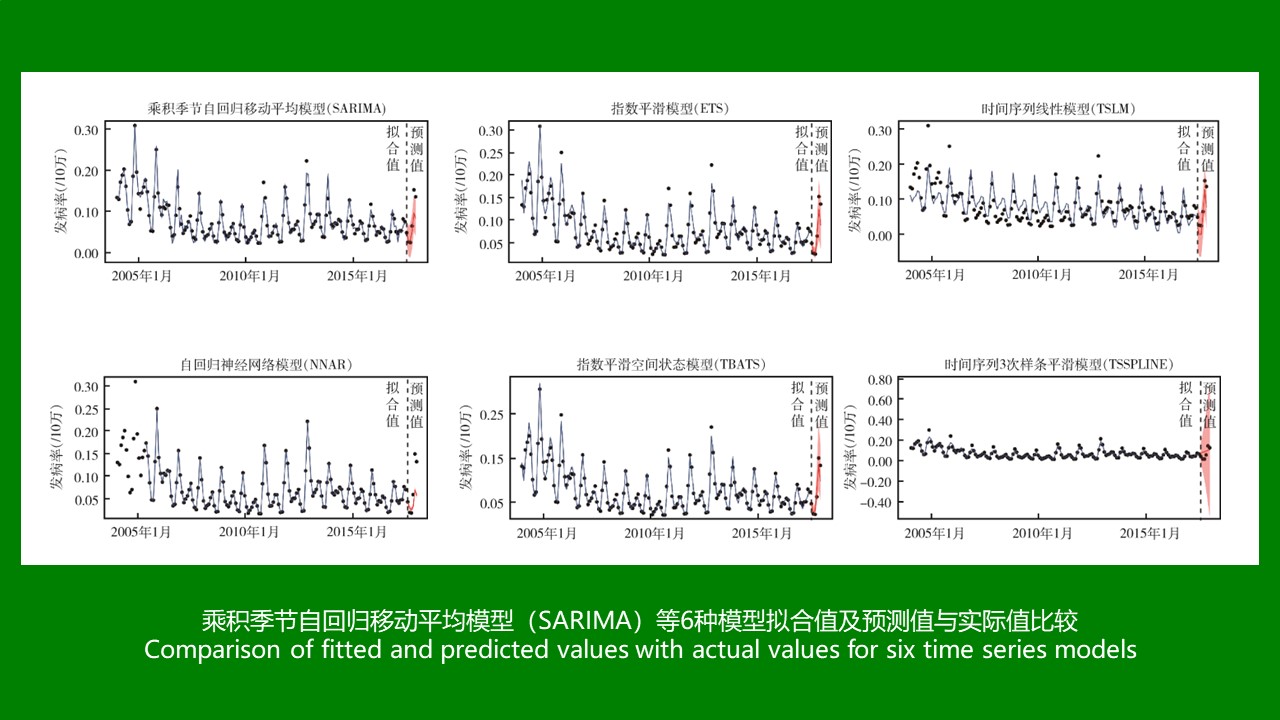
目的 比较7种常用时间序列模型对全国肾综合征出血热(HFRS)发病率拟合及预测的效果,为优化HFRS预警方法提供参考。方法 以2004年1月-2017年6月全国HFRS发病率作为训练数据,建立乘积季节自回归移动平均模型(SARIMA)、指数平滑模型(ETS)、时间序列线性模型(TSLM)、自回归神经网络模型(NNAR)、指数平滑空间状态模型(TBATS)、时间序列3次样条平滑模型(TSSPLINE)和时间序列广义回归模型(TSGRNN),并预测2017年7-12月全国HFRS发病率。以2017年7-12月全国HFRS发病率作为测试数据,比较拟合值与训练数据、预测值与测试数据评价模型拟合及预测效果,评价指标包括平均绝对误差百分比(MAPE)和均数标准差(RMSE)。结果 SARIMA(0,1,4)(2,1,1)[12]为SARIMA最优模型,NNAR(16,1,8)[12]为NNAR最优模型。SARIMA、ETS、TSLM、NNAR、TBATS、TSSPLINE和TSGRNN模型拟合的MAPE、RMSE分别为11.46%、0.01,10.25%、0.01,33.91%、0.03,1.84%、0.00,8.92%、0.01,10.82%、0.01和22.29%、0.02。SARIMA、ETS、TSLM、NNAR、TBATS、TSSPLINE和TSGRNN模型预测的MAPE、RMSE分别为20.51%、0.03,17.22%、0.02,55.27%、0.03,36.27%、0.05,18.03%、0.02,118.82%、0.05和38.71%、0.04。结论 TBATS为最优预测预警模型,适于优化HFRS预警模型。
Objective To compare the performance of seven time series models in fitting and predicting the incidence of hemorrhagic fever with renal syndrome (HFRS) in China, and to provide a reference for optimizing early warning methods for HFRS. Methods The national incidence data of HFRS from January 2004 to June 2017 were used as training data, and the data from July to December 2017 as test data. The training data were used to build the seasonal autoregressive integrated moving average (SARIMA) model, exponential smoothing (ETS) model, time series linear model (TSLM), autoregressive neural network (NNAR) model, TBATS model, time series cubic spline smoothing (TSSPLINE) model, and time series generalized regression neural network (TSGRNN) model. Then these models were used to forecast the national incidence of HFRS from July to December 2017. The model fitting and prediction effect were evaluated by comparing the fitted data with the training data and the predicted data with the test data. The evaluation indicators included mean absolute percentage error (MAPE) and root mean squared error (RMSE). Results SARIMA (0,1,4)(2,1,1)[12] was the optimal SARIMA model, and NNAR (16,1,8)[12] was the optimal NNAR model. The MAPE and RMSE of fitting by SARIMA, ETS, TSLM, NNAR, TBATS, TSSPLINE, and TSGRNN were 11.46% and 0.01, 10.25% and 0.01, 33.91% and 0.03, 1.84% and 0.00, 8.92% and 0.01, 10.82% and 0.01, and 22.29% and 0.02, respectively. The MAPE and RMSE of forecasting by these models were 20.51% and 0.03, 17.22% and 0.02, 55.27% and 0.03, 36.27% and 0.05, 18.03% and 0.02, 118.82% and 0.05, and 38.71% and 0.04, respectively. Conclusion The TBATS model is the optimal model for forecasting and early warning, which is suitable for optimizing the early warning model for HFRS.
[1] Zhang HL, Wang LP, Lai SJ, et al. Surveillance and early warning systems of infectious disease in China:From 2012 to 2014[J]. Int J Health Plann Manage, 2017, 32(3):329-338. DOI:10.1002/hpm.2434.
[2] Yang WZ, Li ZJ, Lan YJ, et al. A nationwide web-based automated system for early outbreak detection and rapid response in China[J]. Western Pac Surveill Response J, 2011, 2(1):10-15. DOI:10.5365/WPSAR.2010.1.1.009.
[3] 方艳, 宋铁, 李灵辉, 等. 广东省传染病自动预警系统运行现状分析[J]. 中华流行病学杂志, 2013, 34(8):800-803. DOI:10.3760/cma.j.issn.0254-6450.2013.08.011. Fang Y, Song T, Li LH, et al. Current situation on the China Infectious Disease Automated-alert and Response System in Guangdong province, China[J]. Chin J Epidemiol, 2013, 34(8):800-803. DOI:10.3760/cma.j.issn.0254-6450.2013.08.011.(in Chinese)
[4] 吕炜, 赖圣杰, 唐忠, 等. 广西壮族自治区2009-2011年传染病自动预警系统运行效果分析[J]. 中华流行病学杂志, 2013, 34(6):589-593. DOI:10.3760/cma.j.issn.0254-6450.2013. 06.012. Lyu W, Lai SJ, Tang Z, et al. Application of the China Infectious Diseases Automated-alert and Response System in Guangxi, 2009-2011[J]. Chin J Epidemiol, 2013, 34(6):589-593. DOI:10. 3760/cma.j.issn.0254-6450.2013.06.012.(in Chinese)
[5] 徐旭卿, 鲁琴宝, 王臻, 等. 浙江省传染病自动预警系统暴发预警效果评价[J]. 中华流行病学杂志, 2011, 32(5):442-445. DOI:10.3760/cma.j.issn.0254-6450.2011.05.004. Xu XQ, Lu QB, Wang Z, et al. Evaluation on the performance of China Infectious Disease Automated-alert and Response System(CIDARS)in Zhejiang province[J]. Chin J Epidemiol, 2011, 32(5):442-445. DOI:10.3760/cma.j.issn.0254-6450.2011.05.004.(in Chinese)
[6] Kuang J, Yang WZ, Zhou DL, et al. Epidemic features affecting the performance of outbreak detection algorithms[J]. BMC Public Health, 2012, 12:418. DOI:10.1186/1471-2458-12-418.
[7] Ceylan Z. Estimation of COVID-19 prevalence in Italy, Spain, and France[J]. Sci Total Environ, 2020, 729:138817. DOI:10.1016/j.scitotenv.2020.138817.
[8] Liu H, Li CX, Shao YQ, et al. Forecast of the trend in incidence of acute hemorrhagic conjunctivitis in China from 2011-2019 using the seasonal autoregressive integrated moving average (SARIMA) and exponential smoothing (ETS) models[J]. J Infect Public Health, 2020, 13(2):287-294. DOI:10.1016/j.jiph.2019.12.008.
[9] Zhai MM, Li WH, Tie P, et al. Research on the predictive effect of a combined model of ARIMA and neural networks on human brucellosis in Shanxi province, China:A time series predictive analysis[J]. BMC Infect Dis, 2021, 21(1):280. DOI:10.1186/s12879-021-05973-4.
[10] Wu W, An SY, Guan P, et al. Time series analysis of human brucellosis in mainland China by using Elman and Jordan recurrent neural networks[J]. BMC Infect Dis, 2019, 19(1):414. DOI:10.1186/s12879-019-4028-x.
[11] Li ZQ, Pan HQ, Liu Q, et al. Comparing the performance of time series models with or without meteorological factors in predicting incident pulmonary tuberculosis in eastern China[J]. Infect Dis Poverty, 2020, 9(1):151. DOI:10.1186/s40249-020-00771-7.
[12] 刘建, 闫佳, 夏军林. 某县一起流行性出血热暴发疫情的调查分析[J]. 河南预防医学杂志, 2020, 31(1):63-65. DOI:10.13515/j.cnki.hnjpm.1006-8414.2020.01.019. Liu J, Yan J, Xia JL. Investigation and analysis of an outbreak of epidemic hemorrhagic fever in a county[J]. Henan J Prev Med, 2020, 31(1):63-65. DOI:10.13515/j.cnki.hnjpm.1006-8414.2020.01.019.(in Chinese)
[13] 刘淑萍. 一起野外施工流行性出血热暴发流行病学分析[J]. 中国公共卫生管理, 2011, 27(1):60-61. DOI:10.19568/j.cnki.23-1318.2011.01.034. Liu SP. Epidemiological analysis of an outbreak of epidemic hemorrhagic fever in field construction[J]. Chin J Public Health Mange, 2011, 27(1):60-61. DOI:10.19568/j.cnki.23-1318. 2011.01.034.(in Chinese)
[14] Hyndman RJ, Khandakar Y. Automatic time series forecasting:The forecast package for R[J]. J Stat Softw, 2008, 27(3):1-22. DOI:10.18637/jss.v027.i03.
[15] Hyndman RJ, Koehler AB, Snyder RD, et al. A state space framework for automatic forecasting using exponential smoothing methods[J]. Int J Forecasting, 2002, 18(3):439-454. DOI:10.1016/S0169-2070(01)00110-8.
[16] De Livera AM, Hyndman RJ, Snyder RD. Forecasting time series with complex seasonal patterns using exponential smoothing[J]. J Am Stat Assoc, 2011, 106(496):1513-1527. DOI:10.1198/jasa.2011.tm09771.
[17] Hyndman RJ, King ML, Pitrun I, et al. Local linear forecasts using cubic smoothing splines[J]. Aust N Z J Stat, 2005, 47(1):87-99. DOI:10.1111/j.1467-842X.2005.00374.x.
[18] Martínez F, Charte F, Rivera AJ, et al. Automatic time series forecasting with GRNN:A comparison with other models[C]//Proceedings of the 15th International Work-Conference on Advances in Computational Intelligence. Gran Canaria:Springer, 2019:198-209. DOI:10.1007/978-3-030-20521-8_17.
[19] Guo YH, Feng Y, Qu FL, et al. Prediction of hepatitis E using machine learning models[J]. PLoS One, 2020, 15(9):e0237750. DOI:10.1371/journal.pone.0237750.
[20] Wang YW, Shen ZZ, Jiang Y. Comparison of autoregressive integrated moving average model and generalised regression neural network model for prediction of haemorrhagic fever with renal syndrome in China:A time-series study[J]. BMJ Open, 2019, 9(6):e025773. DOI:10.1136/bmjopen-2018-025773.
[21] Yu CC, Xu CJ, Li YH, et al. Time series analysis and forecasting of the hand-foot-mouth disease morbidity in China using an advanced exponential smoothing state space TBATS model[J]. Infect Drug Resist, 2021, 14:2809-2821. DOI:10.2147/IDR.S304652.


